
On this page
A candidate sourcing strategy is a written plan for finding, assessing and contacting people who may fit a role.
A useful strategy defines the target candidate, required evidence, search channels, assessment rules, outreach approach and handoff to recruiting. For technical roles, it should connect every must-have to evidence you can inspect. The goal is a focused list of people worth contacting, rather than a large collection of profiles with uncertain relevance.
This matters when you hire developers because titles and keyword matches can hide important differences. Two engineers may list the same language, yet their public work can show different project types, depth and recency. A clear plan helps your team apply the same criteria, record why each person was included and revise the search when the results miss the role.
How does a candidate sourcing strategy work?
A candidate sourcing strategy works by turning a hiring need into repeatable search and review decisions. You define the role, translate it into observable evidence, choose places where that evidence appears, assess potential candidates consistently and prepare relevant outreach. Each step should produce something the next person can inspect and challenge.
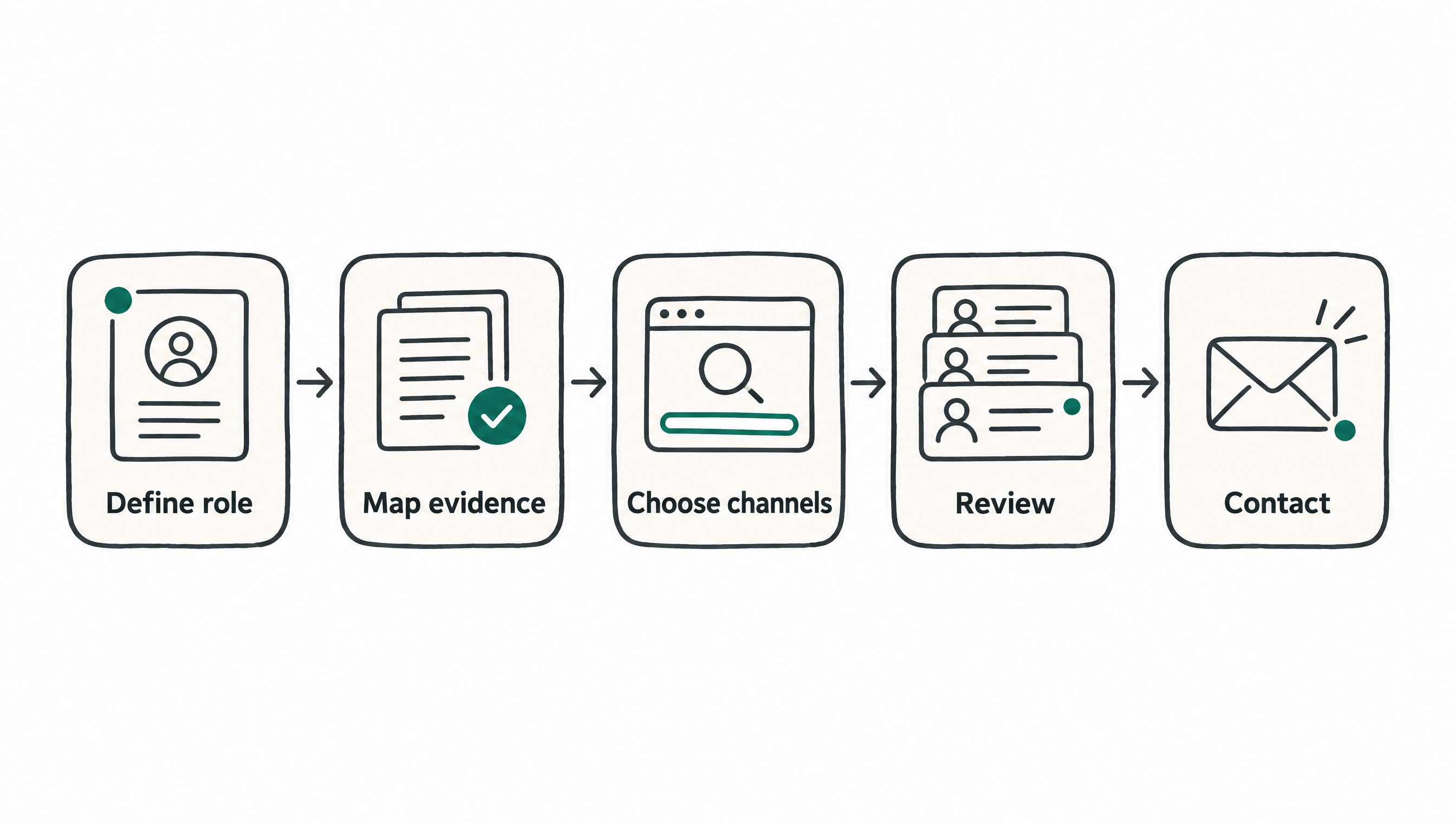
- Define the hiring need. Write down the work the person will do, the conditions they will work under and the requirements that would change your decision. Separate must-haves from preferences. For example, maintaining a production library in Go is more specific than asking for a "strong backend developer."
- Translate requirements into evidence. Decide what would support each requirement before searching. Public repositories, contribution history, project documentation and code related to the role may help with technical sourcing. Evidence should support a reasoned assessment, not become an automatic verdict about ability.
- Choose search channels. Use channels based on where relevant evidence or communities exist. These may include applications, referrals, professional networks, specialist communities, event participants and public technical work. A developer search can include developer candidate discovery based on public GitHub work.
- Review and shortlist. Apply the same must-haves to each profile. Record the evidence, uncertainty and reason for inclusion. Then move the strongest research matches into candidate shortlisting, where the hiring team can review the findings before anyone is contacted.
- Contact and learn. Write outreach around the role and the relevant evidence you found. Track which assumptions prove accurate during conversations. If candidates repeatedly reject the role or fail later checks, revise the target, evidence rules, channels or message instead of merely searching harder.
The video below shows where and how candidate sourcing can be approached in recruiter training.
What parts should the strategy contain?
The strategy should contain a role definition, evidence map, channel plan, review method, outreach plan and learning process. These parts keep sourcing connected to the actual job. They also make gaps visible. If a requirement has no reasonable evidence source, treat it as an open question for conversation rather than pretending the search proved it.
| Part | Question to answer | Developer hiring example |
|---|---|---|
| Role definition | What work must this person do? | Maintain an API used by external customers |
| Evidence map | What could support each requirement? | Relevant repositories, commits or project documentation |
| Channel plan | Where might suitable people appear? | Referrals, communities and public GitHub work |
| Review method | How will profiles be assessed consistently? | A shared must-have checklist with evidence links |
| Outreach plan | Why should this person consider the role? | A specific connection between their public work and the job |
| Learning process | What will cause the plan to change? | Repeated mismatches between sourced profiles and interview needs |
This structure prevents a common failure: starting with a search tool before deciding what a useful result looks like. For example, a query may return many developers who mention Kubernetes. Unless the role definition says what Kubernetes work matters and the evidence map explains what can support it, the result count tells you little about fit.
What are the types of sourcing in recruitment?
Types of sourcing in recruitment can be grouped by how candidates enter the process and where the team finds them. Common categories include inbound interest, direct research, referrals, internal candidates and community-based discovery. A hiring plan can combine them, but each type needs its own evidence, response and follow-up method.
Inbound sourcing starts with people who respond to a job post or otherwise express interest. It can reveal motivation early, but the available pool depends on who sees the role and decides to apply. Your review rules should remain tied to the work rather than using application order as a signal.
Direct sourcing means identifying people before they apply. For a developer role, that can include searching public technical work, then checking whether the available evidence relates to the must-haves. Direct sourcing expands discovery, but public work is incomplete and does not represent every qualified developer.
Referral sourcing starts with introductions from employees or trusted contacts. A referral can provide context, but it should not replace the same job-related assessment used elsewhere. Internal sourcing considers people already working in the organisation. Community sourcing looks in groups built around a technology, practice or shared professional interest.
What are the 5 C's of recruitment?
The "5 C's of recruitment" is not one fixed sourcing standard. Teams use different words for the letters, so treat the phrase as a planning aid rather than an established rule. For candidate sourcing, a practical version is clarity, criteria, channels, contact and calibration. Define each term before using it with your team.
Clarity describes the work, constraints and reason for hiring. A sourcing brief for a developer should explain the system or product they would work on rather than rely on a broad title.
Criteria turns that brief into must-haves and preferences. Each must-have needs a fair way to assess it. If public evidence cannot answer the question, reserve it for a later conversation or structured assessment.
Channels are the places and methods used to find people. Contact covers relevant, respectful outreach and the information a candidate needs to decide whether to reply. Calibration is the team's review of early results. For example, recruiters and engineers can inspect a sample together and correct assumptions before a large search continues.
What are the 7 steps of strategic sourcing?
The "7 steps of strategic sourcing" often refers to procurement, so it should not be treated as an official recruitment method. In candidate sourcing, you can adapt the idea into seven actions: define, prioritise, map evidence, select channels, search, review and learn. The labels matter less than consistent decisions and documented reasons.
Start by defining the role and prioritising its requirements. Then map each requirement to evidence that could reasonably support it. Select channels based on that evidence, conduct the search and review people against the same criteria. Finally, use recruiter, hiring manager and candidate feedback to change weak assumptions.
For example, suppose a team needs a developer who can maintain an open source database connector. The evidence map might include relevant language use, contributions to data tools and maintenance activity. If the search mostly finds tutorial projects, the team can refine the project context or channel rather than lowering standards without discussion.
These steps are a working process, not proof that a candidate can perform the job. Sourcing creates a research-backed starting point. Interviews, work discussions and any lawful assessment process still have separate jobs to do.
What is the golden rule of hiring?
There is no formal golden rule shared by every employer. A sound working rule is to judge people against the job using relevant evidence and a consistent process. In sourcing, that means defining requirements before seeing profiles, recording why each person was selected and keeping unsupported assumptions out of the shortlist.
Consistency does not mean ignoring context. Different candidates may show the same capability through employment, independent projects, community work or private work they can discuss later. The sourcing stage should recognise uncertainty instead of treating missing public evidence as proof that a skill is absent.
For example, a developer with no visible repository may still have extensive relevant experience in private systems. A public-work search cannot assess that experience directly. Keep other sourcing channels open when public activity is unlikely to represent the whole candidate pool.
What is a candidate sourcing strategy not?
A candidate sourcing strategy is not a keyword list, a collection of profile links or a substitute for candidate assessment. It cannot establish a person's full capability, interest, identity or availability from public information alone. It also should not turn convenient signals, such as a familiar employer or school, into hidden requirements.
Sourcing and recruiting are related but different. Sourcing finds and researches possible candidates. Recruiting usually carries the relationship through outreach, conversations, assessment, decisions and hiring. A clean handoff should tell the recruiter why a person may fit, which evidence supports that view and what remains unknown.
A strategy is also not fixed. If early results are irrelevant, the response should be diagnosis. Check whether the role is unclear, criteria are too broad, evidence rules are weak or channels do not contain the target population. Changing a query without resolving those issues can reproduce the same poor shortlist.
When does a public GitHub sourcing strategy not fit?
A public GitHub sourcing strategy does not fit when public code is unrelated to the role, when likely candidates work mainly in private repositories or when the job is poorly represented by software contributions. It should be one input for suitable developer searches, not a universal filter for technical ability or hiring potential.
Public activity can help a team inspect relevant work, but absence is ambiguous. Employment agreements, security requirements, personal preferences and the nature of someone's work may limit what appears publicly. Do not convert "no evidence found" into "cannot do the work." Use applications, referrals and direct conversations to cover that gap.
AyHire searches and evaluates public GitHub work against specified must-haves. It provides evidence-linked profiles, checks whether candidates may be open to work and creates a shared shortlist for team review, according to AyHire's product description. The tool cannot replace interviews or prove qualities that public work does not show.
FAQ
What is the 70/30 rule in hiring?
The 70/30 rule is not a standard candidate sourcing rule with one accepted meaning. If your team uses it to divide time, requirements or candidate groups, define both portions in the sourcing plan. Do not adopt the ratio without explaining what is being measured and why that split suits the role.
What is the 80/20 rule in recruiting?
The 80/20 rule in recruiting is usually an informal application of the Pareto principle, not a hiring standard. Teams may use it to discuss effort or results, but the phrase does not tell you which channels deserve attention. Use your own role-level evidence to decide where sourcing time should go.
What is a candidate sourcing strategy example?
A candidate sourcing strategy example starts with a backend role, defines job-related must-haves, maps them to public work and other evidence, then searches selected channels. The team records evidence for each profile, reviews a sample with the hiring manager, contacts suitable people and adjusts the plan when results expose weak assumptions.
What is the best candidate sourcing strategy?
The best candidate sourcing strategy is the one tied closely to the role and open to correction. It defines observable requirements, uses more than one suitable channel, records evidence and uncertainty, and creates a clear handoff. A strategy that produces many names but little job-related evidence is not working well.
Should I use a candidate sourcing strategy PDF?
Use a candidate sourcing strategy PDF only if a fixed document helps people follow the plan. A shared, editable document is often more useful during calibration because requirements, channels and evidence rules can change. The format matters less than clear ownership, visible decisions and a record of what the team learned.
Sources
- AyHire developer candidate discovery and evidence-backed shortlists
- "Day 3: Candidate Sourcing (Where & How to Find Candidates)" by USITRecruitment
Last checked: 2026-11-18