
On this page
Candidate shortlisting is the process of comparing candidates against defined job criteria and choosing who moves to the next hiring stage. For technical roles, the practical answer is to set the criteria before reviewing people, collect comparable evidence and record why each person advances or does not.
A shortlist is a decision tool, not a final hiring decision. It should help your team focus interviews and assessments on people who meet the role's must haves. This guide explains what being shortlisted means, what happens next, how many people to include, how to review technical candidates and how to communicate decisions. It also includes a candidate shortlisting example and criteria you can adapt without turning the process into an unstructured judgment call.
Is it good if you are shortlisted?
Yes. Being shortlisted means the hiring team has decided that your available evidence matches enough of the role requirements to consider you further. It is a positive step, but it does not mean you have the job. Interviews, assessments, references or other checks may still affect the final decision.
For candidates, a shortlist signals progress. The employer has narrowed the field and wants more information before making a decision. The next request might be a screening call, technical interview, work sample or availability check.
For hiring teams, the word should have a precise internal meaning. Decide which stage someone has reached and what must happen before they move again. If one reviewer uses "shortlisted" to mean "worth contacting" while another means "ready for a final interview," your records and candidate messages will conflict.
A useful shortlist entry records:
- The role and current hiring stage
- The must haves the candidate appears to meet
- The evidence used for each assessment
- Any open questions that need an interview
- The next action, owner and status
Do not treat shortlist status as proof of competence or interest. A resume, profile or public body of work can support a decision to continue, but direct discussion is still needed. The candidate may also decline, be unavailable or decide the role does not fit.
What happens to shortlisted candidates?
Shortlisted candidates usually move into a more focused evaluation stage. The hiring team may confirm interest, explain the role, ask screening questions and arrange an interview or assessment. The exact next step should match the evidence still missing, rather than repeating checks already completed during the initial review.
Start by contacting the candidate with enough context to make an informed response. State the role, why you think it may fit and what the next conversation covers. For sourced candidates who did not apply, do not write as if they have already entered your formal interview process.
Then convert gaps in the shortlist into candidate shortlisting questions. If public work shows experience with a required language but does not explain ownership, ask what the candidate personally designed or maintained. If the role needs collaboration across teams, ask for a specific example and follow up on decisions, constraints and results.
Common next steps include:
- A conversation about interest, scope and availability
- A structured screen based on the same role criteria
- A technical interview focused on relevant work
- A work sample when direct evidence is still needed
- A decision to advance, hold or decline
Keep evaluation separate from scheduling convenience. A candidate who replies quickly is not necessarily a stronger match. A candidate who needs time to arrange an interview is not necessarily less interested.
Tell candidates what will happen after each stage. Clear communication reduces uncertainty and gives your team a record of what was promised. If the process changes, update both the candidate and the internal status.
What is the next step after shortlisted?
The next step is to test the most important unanswered question about the candidate's fit. That may be an initial conversation, structured interview or relevant work sample. Choose the lightest step that can produce the evidence you need, and tell the candidate what the stage covers before asking for their time.
Watch "Candidate Shortlisting Explained: Best Practices, Tools, and Benefits | Smowltech" on YouTube
For technical hiring, review what you already know before scheduling another evaluation. Public code may show technologies, contribution patterns or areas of focus. It may not show the business setting, team responsibilities or reasons behind a technical decision. Build the next stage around those limits.
Use the same core questions for candidates at the same stage. Follow up when an answer needs clarification, but keep the assessed criteria consistent. This makes comparisons easier and reduces the risk that a relaxed conversation with one person is compared with a demanding technical screen for another.
A practical sequence is:
- Confirm that the candidate is interested in discussing the role.
- Verify any must have that remains uncertain.
- Assess the criteria that require direct conversation or work.
- Record evidence and concerns against the scorecard.
- Decide and communicate the next action.
The video below shows candidate shortlisting practices, tools and benefits from Smowltech in English.
Do not add an assessment because it is part of an old hiring routine. Every stage should answer a decision question. If it does not change who advances or what the team needs to learn, remove it.
How many candidates are usually shortlisted for the final interview?
Use the smallest group that contains the candidates who meet your final interview threshold. There is no fixed count that fits every role. Hiring capacity, candidate quality and the amount of evidence already collected should determine the size, not a target chosen before the team has reviewed the pool.
A forced quota creates two problems. You may advance someone who does not meet the threshold merely to fill a place, or reject a qualified person because the list is already full. A threshold based on role criteria is easier to explain and apply.
Before inviting anyone to a final interview, ask:
- Does the candidate meet every genuine must have?
- Is there enough evidence to support that assessment?
- Are the remaining questions suitable for a final interview?
- Can the interview panel give each candidate a comparable process?
- Is the role still aligned with what the candidate wants?
Panel capacity still matters. If the shortlist is larger than the team can assess promptly and consistently, revisit the earlier stage. You may need a focused screen that resolves a shared uncertainty before scheduling final interviews.
Do not change the final interview threshold after seeing a candidate's name, employer or educational background. If a criterion turns out to be unnecessary, revise it for everyone and record why. Apply the updated version to candidates already reviewed where possible.
How does candidate shortlisting work?
Candidate shortlisting works by defining job related criteria, gathering comparable evidence, applying the same decision rules and recording the result. For developer hiring, evidence may include application material, interview responses and relevant public work. Human reviewers remain responsible for interpreting that evidence and deciding who should move forward.
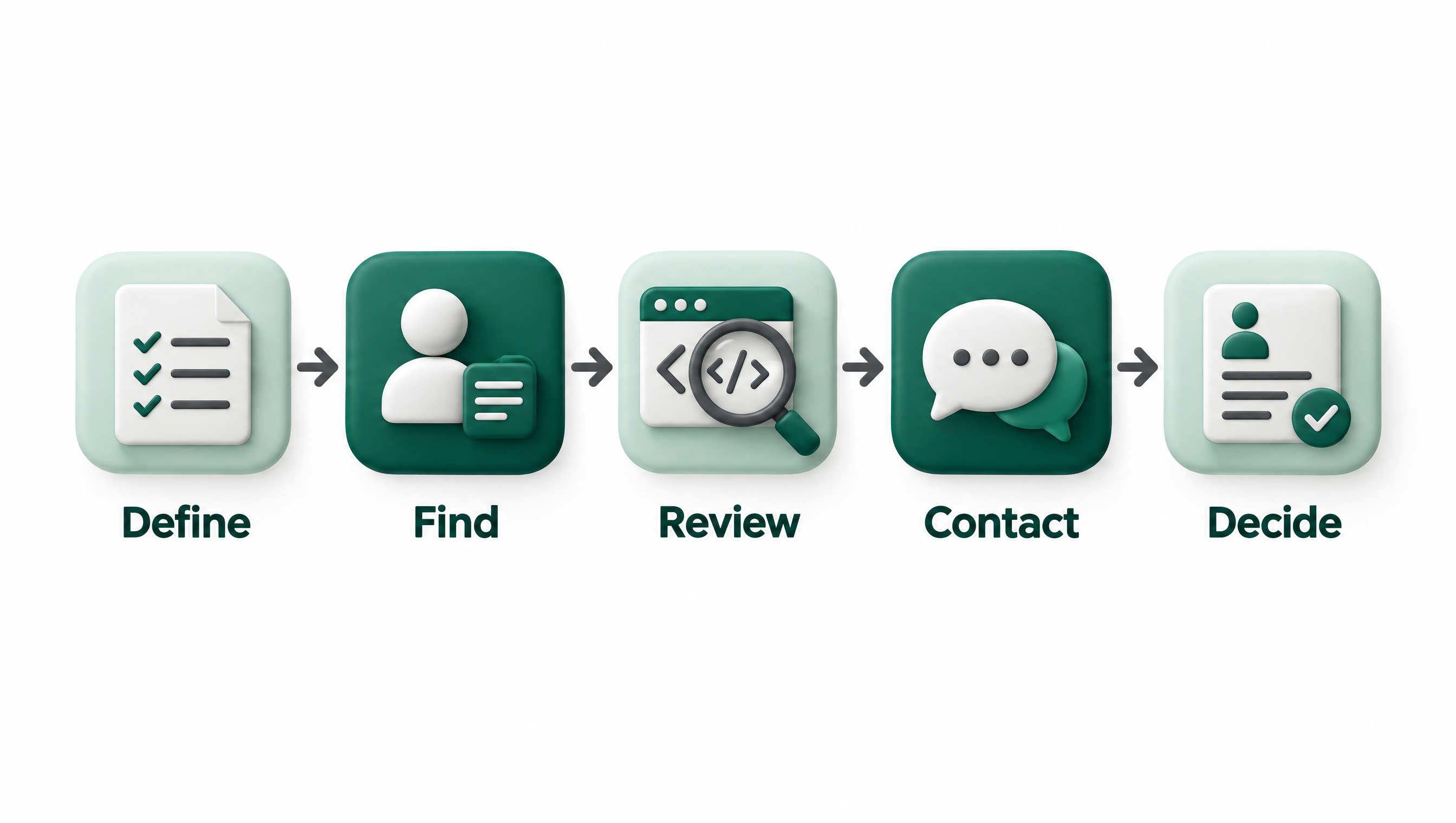
Begin with the work the person will do. Translate that work into must haves and useful preferences. A must have should be necessary for the role at the point of hire, not merely familiar or convenient for the team.
Shortlisting criteria examples for a developer role might include:
- Evidence of work in a required programming language
- Experience with a relevant technical problem
- Ability to explain design choices and trade offs
- Availability that fits a stated role requirement
- Work authorization when it is legally required for the role
Keep preferences separate from requirements. A preference can help distinguish candidates who already meet the threshold, but it should not quietly become a reason to reject someone. Avoid criteria that act as substitutes for the skill you actually need.
Next, decide what counts as evidence. A profile keyword can point reviewers toward relevant work, but it does not prove depth. A repository can provide material for review, but contribution history still needs context. Record both supporting evidence and uncertainty instead of converting every signal into a confident judgment.
AyHire supports developer candidate discovery by searching for people who match a role description and evaluating public profiles against specified must haves. It presents findings with supporting links, checks whether candidates may be open to work and creates a shared shortlist for team review. The product supports research and review. It does not make the hiring decision.
A candidate shortlisting example might look like this:
A team needs a developer with relevant language experience and evidence of maintaining production oriented software. Reviewers define both requirements before searching. Candidate A has linked public work that supports the language requirement, but maintenance ownership is unclear. The team shortlists Candidate A for a structured conversation and records ownership as the question to resolve.
This example does not treat missing public evidence as proof that a candidate lacks a skill. It treats the gap as an open question. If the requirement can be checked fairly in the next stage, the team can continue without inventing certainty.
Use this summary when designing your process:
| Stage | Team action | Evidence to record | Candidate outcome |
|---|---|---|---|
| Define | Set job related must haves and preferences | Reason each criterion matters | Clear evaluation basis |
| Find | Gather applications or identify possible candidates | Source and role relevance | Pool for review |
| Review | Compare available evidence with the criteria | Support, gaps and uncertainty | Advance, hold or decline |
| Contact | Confirm interest and explain the role | Candidate response and constraints | Screen or close |
| Assess | Ask consistent questions about open points | Answers, work and reviewer notes | Final decision stage |
| Decide | Compare evidence with the stated threshold | Decision reason | Advance or decline |
When your team needs an evidence backed starting point for a developer search, use AyHire to create a shortlist for human review. Keep ownership of the criteria, outreach, interviews and final decision with the hiring team.
What candidate shortlisting cannot do
Candidate shortlisting cannot prove that someone will perform well, accept the role or work effectively with a particular team. It also cannot make incomplete public information complete. A sound process narrows attention and identifies questions. It does not remove the need for direct, fair evaluation or human judgment.
Public GitHub work covers only what a developer has made visible there. It may omit private employment, confidential projects and skills demonstrated elsewhere. Lack of public work should not be treated automatically as lack of ability.
Shortlisting tools also do not decide whether your criteria are appropriate. If the team starts with vague, excessive or unrelated requirements, a consistent process can still produce poor decisions. Review each criterion for a direct connection to the work.
Candidate shortlisting may not fit when:
- The role has not been defined well enough to set a threshold.
- The team cannot explain what evidence would satisfy a requirement.
- Applicants need an accommodation that changes how evidence is gathered.
- The available information is too limited for a fair comparison.
- A legal or policy question needs qualified review.
Do not use an automated result as the sole reason to reject someone. Review the underlying evidence, allow for missing context and provide a path for human correction. AyHire can organize evidence from public developer work, but it cannot conduct interviews, verify private experience or make the final hiring choice.
FAQ
Is it good if you are shortlisted?
Yes. It means the hiring team sees enough potential fit to consider you for another stage, but it is not a job offer.
How long does shortlisting usually take?
The timing depends on the size of the candidate pool, the clarity of the criteria and reviewer availability. Hiring teams should set an internal review schedule and tell candidates when they can expect an update.
What happens to shortlisted candidates?
Shortlisted candidates usually receive a request for a screening conversation, interview, assessment or another check tied to the role. The hiring team should explain the stage and what follows it.
What is the next step after shortlisted?
The next step is usually an evaluation that addresses the most important evidence still missing. It may be an interest call, structured interview, technical discussion or relevant work sample.
Does shortlisted mean you got the job
No. Shortlisted means you remain under consideration and have moved beyond an earlier review, not that the employer has made a final offer.
Candidate shortlisting questions
Candidate shortlisting questions should test stated role criteria and resolve gaps in the available evidence. Ask every candidate the same core questions, then use focused follow ups to clarify individual answers.
Shortlisting criteria Examples
Examples include evidence of a required technical skill, experience with a relevant problem, ability to explain decisions and any genuine availability or authorization requirement. Each criterion should connect directly to the work.
Shortlist or short list
"Shortlist" is commonly used as a noun or verb in hiring, while "short list" may appear as two words. Choose one style and use it consistently in candidate communication and internal records.
Ready to research developers against defined role requirements? Start with AyHire, then review the linked evidence and make each hiring decision as a team.
Sources
- AyHire developer candidate discovery and evidence backed shortlists
- Indeed guide to being shortlisted for a job
- BrynQ shortlisting overview
- Smowltech candidate shortlisting video
Last checked: 2026-10-29