
On this page
Recruiting web developers is difficult when a job title hides major differences in frameworks, product work and technical depth. The practical answer is to combine a clear role scorecard with a sourcing method that exposes relevant work, then assess every candidate against the same must-haves. This guide compares four option types: public-work research, job boards, recruiter-led search and referrals.
We have not ranked named providers because comparable evidence was not available for at least three options. Instead, we assess each option by evidence quality, reach, internal effort, candidate intent and pricing basis. For teams that need to find developers with visible public work, public-profile research is the most direct starting point. Your best choice can differ when you need active applicants, specialist search support or trusted introductions.
The short answer
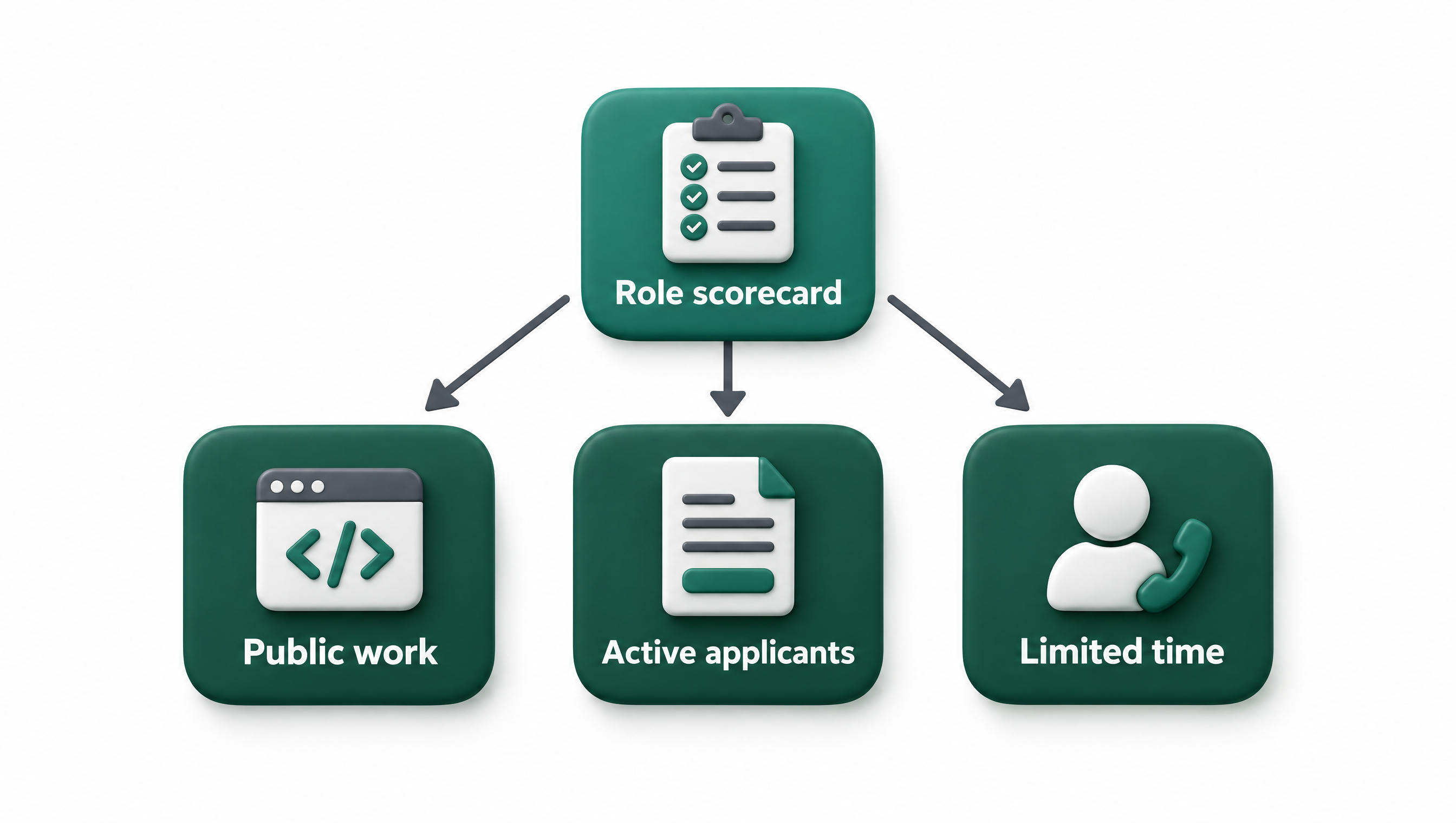
Start with the channel that addresses your hardest constraint. Public-work research helps you inspect demonstrated technical activity, job boards collect active applicants, recruiter-led search transfers more sourcing work outside your team, and referrals provide a trusted introduction. Most hiring processes benefit from one main sourcing channel and a consistent assessment method.
- Public-work research: Best for finding developers whose public technical work can be checked against role requirements.
- Job boards: Best for reaching people who are actively looking and willing to submit an application.
- Recruiter-led search: Best for teams that want another party to manage candidate sourcing and initial contact.
- Employee and professional referrals: Best for reaching people through trusted professional connections.
| Option type | What it does | Best for | Pricing basis |
|---|---|---|---|
| Public-work research | Finds developers through public technical profiles and work | Evidence-led sourcing | Varies by tool; AyHire pricing not published |
| Job boards | Publishes a role and collects applications | Active applicants | Varies by provider |
| Recruiter-led search | Sources and contacts candidates for an employer | Teams with limited sourcing capacity | Varies by provider or agreement |
| Employee and professional referrals | Invites introductions from known contacts | Trusted introductions | Internal policy or arrangement |
How we assessed these options
We assessed the option types by what a hiring team can inspect, how the method reaches candidates, how much work remains with the team and whether candidate interest is known. We did not rank them by popularity, job volume, placement rate or price because comparable figures were not available.
AyHire is our product. We include public-work research according to the same criteria as the other option types, rather than placing it first by default.
The five questions behind the comparison are:
- Can you inspect relevant evidence? A profile or application should help you check the must-haves in your scorecard.
- Does the method reach the right candidate pool? Active applicants and developers who are not applying require different routes.
- How much internal work does it require? Sourcing, outreach, screening and technical assessment all need an owner.
- Can you tell whether a candidate may be interested? Technical fit does not establish current interest in a role.
- Is the pricing basis clear? Compare the whole process rather than one sourcing fee in isolation.
This is a guide to choosing a method, not a claim that one option works for every web developer role. The result still depends on the role definition, outreach, interview design and the decisions made by your hiring team.
What does public-work research offer?
Public-work research starts with technical activity that a developer has made visible, then compares that evidence with your role requirements. It can help when titles and short resumes do not explain what someone has worked on. Its main limit is equally important: private commercial work may not appear in public profiles, so absence of public evidence does not prove absence of skill.
Developer candidate discovery from AyHire searches for people matching a role description and evaluates their public profiles against specified must-haves. AyHire examines public GitHub work, presents findings with supporting profile links, checks whether candidates may be open to work and creates a shared shortlist for the hiring team to review.
Best for
- Roles where relevant public GitHub work can support an initial fit assessment.
- Teams that want supporting links behind candidate findings before outreach.
Strengths
- AyHire compares public profiles with must-haves specified for the role.
- Its shortlists include supporting profile links and open-to-work status.
- Searches and shortlists are available through Claude Code, Codex, Cursor and other agents over MCP.
Limits
- It cannot assess technical work that a candidate has not made public.
- Public profile evidence cannot replace an interview or work-relevant assessment.
- AyHire pricing is not published in the available product information.
Who should skip it
Skip public-work research as your main channel if the role rarely produces visible public work, or if you need a large pool of people who have already chosen to apply. A job board may fit that need more directly.
For a closer look at adjacent sourcing products, compare these GitHub recruiting tools.
When should you use a job board?
Use a job board when you want candidates to find the role and submit an application. This route gives you a clear signal of interest at the time of application, but it places screening responsibility on your team. The quality of the result depends heavily on how clearly the role and requirements are described.
A useful posting separates required capabilities from preferences. State what the developer will build, the constraints they will work within and how the interview will assess relevant skills. Avoid turning every technology used by the team into a mandatory requirement, since that makes the scorecard harder to apply consistently.
Best for
- Teams that want applications from active job seekers.
- Roles that can be described clearly enough for candidates to assess their own fit.
Strengths
- Candidates actively choose to apply for the advertised role.
- The same job description can provide a common starting point for screening.
- Applications can capture information requested by the hiring team.
Limits
- Your team must review and compare incoming applications.
- A resume may state a skill without providing inspectable work evidence.
- The channel may not reach suitable developers who are not searching job listings.
Who should skip it
Do not rely on job boards alone if your target candidates are unlikely to be applying. Add a direct sourcing method when the role requires a narrow technical background or when evidence from past work matters before contact.
When does recruiter-led search fit?
Recruiter-led search fits when your team wants outside help with sourcing, outreach or early screening. Before choosing this route, define which tasks the recruiter owns and what evidence must accompany each candidate. A long list of profiles is less useful than a smaller set assessed against an agreed scorecard.
Ask how the recruiter distinguishes a web developer who has used a framework from one who has owned relevant production work. Agree on the required notes for each submission, the process for handling candidate interest and who answers technical questions during outreach.
Best for
- Hiring teams with limited time for direct sourcing and initial contact.
- Searches where market knowledge and repeated outreach are important.
Strengths
- The recruiter can take ownership of agreed sourcing and contact tasks.
- A defined brief gives both parties a shared basis for candidate review.
- The approach can be paired with your own technical interview process.
Limits
- Quality depends on the recruiter understanding the role and applying the brief accurately.
- Your team still needs to validate technical fit.
- Pricing and terms vary by provider or agreement.
Who should skip it
Skip this option if nobody on your team can define the role, review submissions or make timely decisions. Moving sourcing outside the company does not remove the need for an accountable hiring manager and a consistent technical assessment.
When do referrals work best?
Referrals work best when employees or professional contacts know developers whose work and collaboration they can describe. The introduction can add useful context, but it should not change the hiring standard. Referred candidates should receive the same role information, assessment criteria and decision process as other candidates.
Ask the referrer what they directly observed. A specific account of work completed together is more useful than a general recommendation. Keep the referrer separate from the final decision where possible, and record assessment evidence in the same format used for every candidate.
Best for
- Teams with relevant professional networks.
- Roles where a trusted introduction may start a useful conversation.
Strengths
- Referrers can explain the context in which they know a candidate.
- An introduction can connect the hiring team with someone who is not browsing job listings.
- Referrals can work alongside job postings and direct research.
Limits
- The available pool depends on the reach and variety of your network.
- Personal confidence is not proof of fit for a particular role.
- Referrals can produce inconsistent decisions if they bypass the normal assessment.
Who should skip it
Do not make referrals your only route if your network is narrow or repeatedly produces similar candidate profiles. Use the same scorecard for referred and non-referred candidates, then add another sourcing channel to widen the pool.
How should you choose?
Choose by identifying the first unresolved problem in your hiring process. If you lack candidates, focus on reach. If you have many applicants but weak evidence, improve sourcing filters and assessment. If internal time is the constraint, decide which work can move to a recruiter without giving up technical review.
Watch "Recruiting a Web Developer" on YouTube
Choose public-work research for inspectable technical evidence
Use public-work research when a role has must-haves that can be checked against visible repositories, contributions or profile activity. Decide in advance what counts as relevant evidence. Do not reject someone only because private work is absent from a public profile.
The video below shows an approach to recruiting a web developer and can help frame the wider hiring task before you choose a sourcing channel.
Choose job boards for active applicants
Use a job board when candidate intent matters at the start and your team can manage application review. Write the posting from the scorecard. The screening process should distinguish required evidence from keywords that happen to appear in a resume.
Choose recruiter-led search when internal sourcing time is limited
Use recruiter-led search when you can give the recruiter a precise brief and review submissions promptly. Define ownership for sourcing, outreach, scheduling and candidate communication before the search begins. Keep technical judgment with people who understand the work.
Choose referrals as a supporting channel
Use referrals to add trusted introductions, not to replace assessment. Ask what the referrer observed directly and record that context. Apply the same interview stages and decision rules used for candidates from other channels.
Before starting outreach, write a short scorecard with the work to be done, the true must-haves and the evidence you will accept. If public GitHub work is relevant, use AyHire for developer candidate discovery and review each evidence-linked profile as a team.
FAQ
Recruiting web developers salary
Set salary from the role's scope, level, location and employment arrangement, then check current market data for the place where you hire. Publish a range where your policy and applicable rules allow it. Do not infer expected salary from a public GitHub profile, and confirm expectations directly before a lengthy interview process.
Recruiting web developers jobs
Start a web developer job search with a specific description of the work rather than a broad title. State the product area, expected responsibilities, required capabilities, location or remote arrangement and assessment process. Use job boards for active applicants, then add direct research, recruiter-led search or referrals when the role needs wider reach.
What should a web developer scorecard include?
A web developer scorecard should include the work outcomes, required capabilities and evidence you will accept. Separate must-haves from preferences. Use the same scorecard during sourcing, screening and final review so that the standard does not change between candidates.
Can GitHub replace a technical interview?
No, GitHub should not replace a technical interview. Public work can support initial research and give interviewers specific topics to discuss, but it may omit private work and does not establish every skill needed for the role. Use it as one source of evidence.
Should we use more than one recruiting channel?
Yes, use more than one channel when a single route does not provide enough reach or evidence. For example, a job board can collect active applicants while public-work research finds developers who are not applying. Keep one scorecard across both channels.
How do we compare candidates from different sources?
Compare candidates against the same role requirements and record the evidence behind each assessment. Do not give a referral a lower standard or assume a direct-sourced candidate is interested. Separate technical fit, candidate interest and interview performance in your notes.
When should we contact a developer found through public work?
Contact a developer after you can explain why their visible work appears relevant to the role. Keep the message specific, identify the opportunity clearly and avoid claiming that public activity proves full suitability. Give the person a straightforward way to decline further contact.
What cannot a sourcing tool decide for us?
A sourcing tool cannot make the final hiring decision for your team. It cannot inspect private work that it cannot access, confirm every claim or replace direct discussion with the candidate. Your team remains responsible for assessment, communication and the final decision.
Sources
Last checked: 2026-10-31