
On this page
Searching for LinkedIn Recruiter alternatives usually means some part of your sourcing process no longer fits. You may need better evidence of technical work, a different candidate pool, clearer team review or a tool focused on developers. The confirmed product alternative covered here is AyHire, while three broader option types help you decide whether you need discovery, applications, workflow management or direct outreach.
A LinkedIn Recruiter alternative is any tool or sourcing method that replaces part of candidate discovery, evaluation, contact or hiring workflow. AyHire is the most relevant option here when your main problem is finding developers and checking public GitHub work against role requirements. LinkedIn Recruiter may still fit teams that want to keep sourcing within LinkedIn and already have a working process there.
Why do people look for alternatives?
Teams usually look elsewhere when they need a different source of candidate evidence, want applications instead of outbound sourcing, or need hiring workflow software rather than another search tool. Start by naming the part you want to replace. This prevents you from comparing products that solve different problems.
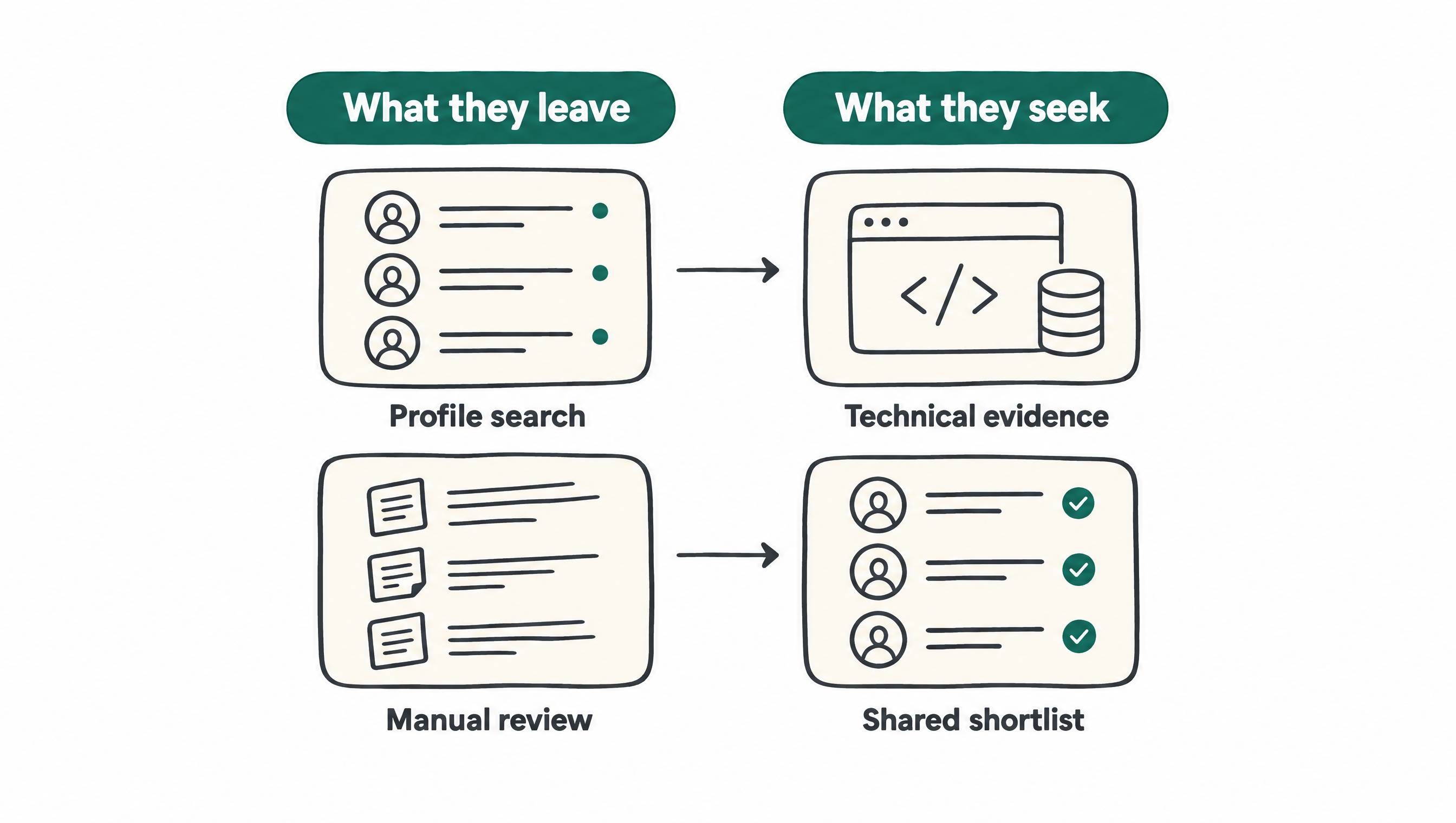
Common reasons include:
- You want to assess public technical work before contacting a developer.
- Your team needs findings linked to evidence for review.
- You want candidates to apply through a job listing.
- You need one place to manage applicants already in your process.
- You prefer direct research through technical communities and public profiles.
- You want sourcing to work inside an agent-based workflow.
A switch does not have to replace every part of LinkedIn Recruiter. You can keep LinkedIn for professional profiles while using another method for technical assessment, applications or candidate management.
| Option | What it does | Best for | Pricing basis | How it differs from LinkedIn Recruiter |
|---|---|---|---|---|
| AyHire | Searches for developers and evaluates public profiles against role must-haves | Evidence-based developer discovery | Not published | Focuses on public GitHub work, evidence-linked findings and team shortlists |
| Job boards | Invite candidates to apply to an advertised role | Teams that prefer inbound applications | Varies by provider | Starts with applications rather than direct candidate discovery |
| Applicant tracking systems | Organize applicants and hiring stages | Teams that already have candidate flow | Varies by provider | Focuses on managing a process rather than finding technical evidence |
| Technical communities and direct sourcing | Let recruiters research people through public technical activity | Teams prepared for manual research | Depends on the sources and workflow used | Uses technical communities and public work as starting points |
The options are ordered by relevance to teams hiring developers, not by a claim that one is best overall. AyHire is our product, so its inclusion has a commercial relationship. We have not ranked it above named competitors because comparable product evidence was not available.
Is AyHire the right alternative for developer discovery?
AyHire fits when you need to identify developers, assess public GitHub work against specified must-haves and give your team evidence to review. It is a focused research option rather than a general professional network. Consider it when technical evidence matters before outreach.
AyHire takes a role description and searches for people whose public profiles may match it. Its findings include links supporting each assessment, an indication of whether a candidate may be open to work and a shared shortlist for team review. You can explore developer candidate discovery to see how that workflow is positioned.
The product also makes role searches and shortlists available through Claude Code, Codex, Cursor and other agents over Model Context Protocol. That can matter if your team wants candidate research available inside an existing agent workflow rather than isolated in another browser tab.
Honest limits: AyHire is built around developer hiring and public GitHub evidence. It cannot assess private work or prove that public activity represents every skill a candidate has. An open-to-work check is a research signal, not confirmation that someone wants your particular role.
Stay with LinkedIn Recruiter if your process depends mainly on LinkedIn profiles and you do not need public code evidence. AyHire can also sit beside LinkedIn rather than replace it completely.
Are job boards a better alternative for inbound hiring?
Job boards are the better type of option when you want interested candidates to come to you through an advertised vacancy. They solve an inbound hiring problem, not the same research problem as a developer discovery tool. Evaluate them by applicant relevance and the review work they create.
A job board can reduce the need to identify every prospect manually. You publish a role, receive applications and decide whom to advance. This approach may suit recognizable employers, roles with an active candidate market or teams that prefer consent through application before evaluation.
The main limit is that an application does not automatically provide evidence for each technical requirement. Your team may still need portfolio review, technical screening or public work research. Results can also depend on the role, listing and audience, so test with a real vacancy rather than relying on broad claims.
Stay with LinkedIn Recruiter if outbound sourcing remains central and you want to search for people who have not applied. Choose a job board when application flow is the actual goal.
Is an applicant tracking system the alternative you need?
An applicant tracking system fits when your main problem starts after candidates enter the process. It can organize applications, stages and team decisions, but it is not automatically a replacement for candidate discovery. Separate sourcing needs from process management before buying another system.
Ask where the work is breaking down. If recruiters already find enough relevant people but lose context during review, a system of record may be more useful than a new search product. If the pipeline is empty, candidate management alone does not address that gap.
Check whether a system supports your current interview stages, ownership rules and review process. Use a sample role to see how easily the team can find evidence behind a decision. Pricing and exact features vary by provider, so compare current first-party information before committing.
Stay with LinkedIn Recruiter if the missing capability is prospect search rather than applicant organization. In many teams, sourcing and applicant tracking remain separate parts of the process.
Can technical communities and direct sourcing replace LinkedIn Recruiter?
Technical communities and public developer profiles can support direct sourcing when you want to inspect visible work yourself. This route gives your team control over research criteria, but it also creates manual work. It fits small searches where recruiters understand the technical signals they are reviewing.
Watch "Best LinkedIn Recruiter Alternatives For 2026" on YouTube
Start with the role's actual must-haves. Look for public work that may demonstrate those requirements, then record the link and why it matters. Avoid treating repository activity, follower counts or one visible project as a complete assessment of the person.
This option has clear limits. Public work may be incomplete, outdated or unrelated to a candidate's paid experience. Some strong developers keep little public code, and private employer work will not appear. Manual research also becomes harder to apply consistently as the number of roles grows.
Stay with LinkedIn Recruiter if professional profile search is more useful to your team than technical source review. Choose direct sourcing when you can define evidence standards and apply them consistently.
The video below shows additional LinkedIn Recruiter alternatives discussed by Wiza and can help you create a wider product shortlist before checking each vendor's current claims.
How do you choose between LinkedIn Recruiter alternatives?
Choose by identifying the job you need the alternative to perform, then test it on one real role. Compare the quality of evidence, the time required for review and how well the output fits your team's process. Do not start with a feature count.
Use these decisions:
- Do you need discovery or management? Choose a sourcing option when you lack candidates. Consider an applicant tracking system when candidates already exist but the process is difficult to manage.
- Do you want inbound or outbound hiring? Use job boards for applications. Use candidate discovery or direct research when you need to identify people who have not applied.
- Does technical evidence matter before contact? Consider AyHire or a documented direct research process when public GitHub work should inform the shortlist.
- Can your team verify each assessment? Prefer findings linked to their underlying evidence. A score without context is harder to challenge or correct.
- Will the option fit your existing workflow? Test how roles enter the tool, how reviewers share findings and how decisions leave it.
A practical test
Run the same developer role through each option you are considering. Keep the must-haves fixed and record whether each candidate finding has enough evidence for a reviewer to check. Note where manual work appears, including duplicate review and moving information between systems.
Do not treat a larger result set as a better result by default. A shorter list may be more useful when every profile has a clear reason for inclusion. You should also inspect false matches and candidates the method may exclude.
If your priority is developer discovery from public technical work, review AyHire with a real role and decide whether its evidence-linked shortlist fits your team's standards.
FAQ
These questions cover the practical issues people raise when comparing LinkedIn Recruiter alternatives, including other sourcing routes, private job-seeking signals and whether LinkedIn remains useful. The answers separate candidate discovery, technical evidence and professional presence so you can make a narrower decision.
What else besides LinkedIn?
You can use developer research tools, job boards, applicant tracking systems or direct sourcing through technical communities and public profiles. The right category depends on whether you need to discover candidates, attract applications, manage a pipeline or review technical work. AyHire is a focused option for finding developers through public GitHub evidence.
How to make LinkedIn open to work for recruiters only?
Use LinkedIn's own visibility controls when setting your job-seeking preferences and review the current audience shown before saving. Interface details can change, so confirm the setting inside your account. Treat any open-to-work indicator as a starting signal, then ask the person directly about interest in the role.
Why are people getting rid of LinkedIn?
People may reduce their reliance on LinkedIn when another source better fits the task they need to complete. A developer hiring team might want public technical evidence, while another team may prefer inbound applications or direct community research. That does not mean LinkedIn has no place in the process.
Is LinkedIn still worth it in 2026?
LinkedIn can still be worth using when its professional profiles and recruiter workflow match how your team sources. The decision should depend on your roles, candidate pool and review process rather than the year alone. Test it against a real alternative using the same role requirements.
Is it a red flag if you don't have LinkedIn?
No, the absence of a LinkedIn profile should not decide whether someone is qualified. Some candidates use other public profiles, keep a limited online presence or cannot share private work. Assess evidence relevant to the role and give candidates a way to explain experience that is not public.
Sources
Product statements about AyHire come from its official website. The linked video is included as a separate overview from Wiza, not as evidence for AyHire's product claims or for pricing. Readers should verify changing interfaces, availability and commercial terms with each provider.
Sources: AyHire official website; "Best LinkedIn Recruiter Alternatives For 2026" by Wiza
Last checked: 2026-11-25