
On this page
Hiring a Golang developer gets difficult when every route solves a different part of the problem. If you need to hire Golang developers, choose between direct candidate research, job listings, developer communities and contract talent networks based on the role, available evidence and engagement model. For many technical teams, direct research is the practical starting point because it lets you inspect relevant public work before deciding whom to contact.
A Golang developer is a software developer who uses Go to build or maintain software. This guide compares four kinds of hiring route rather than ranking named services, because there is not enough consistent evidence here to make a fair product ranking. Use it to decide where to search and what to check before interviews.
The short answer
The right route depends on whether you need to discover experienced contributors, collect applications, reach people in a community or fill a contract role. Start with the route that matches your hiring model, then verify each candidate against the same role-specific requirements.
- Direct candidate research: Best for finding developers through relevant public GitHub work.
- General or Go-focused job listings: Best for attracting people who are actively applying.
- Developer communities: Best for reaching specialists through trusted, topic-specific spaces.
- Contract talent networks: Best for a defined project or a flexible contract engagement.
| Option | What it does | Best for | Pricing basis |
|---|---|---|---|
| Direct candidate research | Finds potential candidates and evaluates public work against role requirements | Evidence-led outbound hiring | Not published |
| General or Go-focused job listings | Publishes a role so interested developers can apply | Inbound applications | Not published |
| Developer communities | Connects hiring teams with people discussing or working with Go | Specialist outreach and referrals | Not published |
| Contract talent networks | Matches companies with developers available for contract work | Projects and flexible engagements | Not published |
How we ranked these
We did not rank named providers. There were fewer than three confirmed options with comparable evidence, so assigning positions would imply a level of certainty the available information does not support. Instead, we assessed the main routes by search method, evidence available before contact, likely candidate intent and employment model.
These criteria help you compare unlike options without treating them as interchangeable:
- Search method: Decide whether you want to find people directly or wait for applications.
- Technical evidence: Check what you can review before an interview, such as public code, project history or an application portfolio.
- Candidate intent: Separate people who may be open to contact from people actively applying.
- Engagement model: Decide whether you need an employee, an intern, a freelancer or a contract developer.
- Team effort: Account for the work required to search, review profiles, contact candidates and manage applications.
We did not assess popularity, ratings or salary claims because comparable evidence was unavailable. AyHire is our own product. We include it only as an example of direct candidate research, not as a ranked winner.
What should you look for when you hire Golang developers?
Look for evidence that matches the work in your role rather than using Go as the only filter. A useful review connects your must-haves to observable projects, explains what the candidate appears to have contributed and identifies questions that still need to be answered in an interview.
Watch "Do Tech Jobs Exist for Golang Developers?!" on YouTube
Start by writing a short role brief. Name the systems the person will work on, the level of ownership expected, the engagement model and any requirements that would rule out a candidate. Avoid turning every preference into a must-have, since an overloaded search can hide otherwise suitable people.
Check these areas consistently:
- Relevant work: Look for projects connected to the problems in your role.
- Contribution context: Distinguish between owning work and making a small contribution.
- Recent evidence: Ask whether the available work still reflects the candidate's current skills.
- Communication: Use the interview to explore decisions, trade-offs and collaboration.
- Availability: Confirm interest, location constraints and the preferred working arrangement directly.
Public work is useful evidence, but it is incomplete. Private company projects may represent much of a developer's experience, and an inactive public profile does not prove that someone is inactive professionally. Treat repository evidence as a way to form better questions, not as a replacement for interviews or references.
The video below shows one developer's discussion of whether technology jobs exist for Golang developers.
What are the main kinds of hiring options?
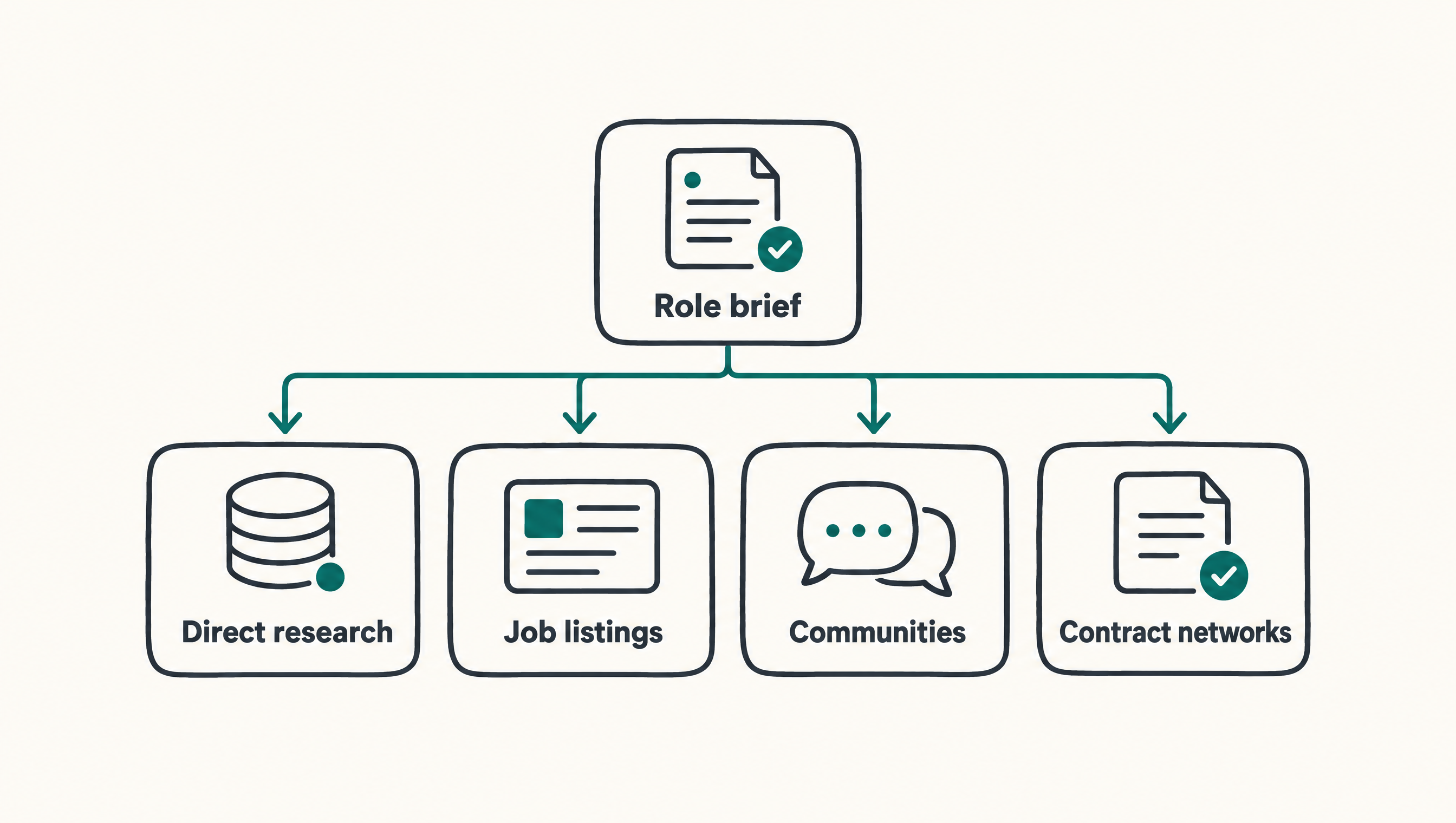
The four practical routes are direct candidate research, job listings, developer communities and contract talent networks. Each route gives you a different mix of reach, candidate intent and evidence. You can combine them, but each should feed into one consistent review process.
Direct candidate research
Direct research starts with your role requirements and searches for people whose public work appears relevant. AyHire's developer candidate discovery searches public GitHub work, evaluates profiles against specified must-haves, checks whether candidates may be open to work and creates an evidence-linked shortlist for team review.
Best for
- Teams prepared to contact prospective candidates directly.
- Roles where public technical work can inform the first review.
Strengths
- Supports searches based on role-specific requirements.
- Links profile findings to supporting evidence.
- Gives the team a shared shortlist to review.
Limits
- Public profiles do not contain every relevant skill or project.
- An open-to-work indication still requires direct confirmation.
- AyHire identifies people to review. It does not make the hiring decision for you.
Skip this route if your team cannot support outbound contact or if the role has little connection to work that candidates can show publicly.
General or Go-focused job listings
Job listings invite interested developers to apply. A focused listing should explain the work, employment model and must-haves clearly enough that candidates can decide whether the role fits. General job sites may offer broad reach, while Go-focused listings can place the role in front of a more specific audience.
Best for
- Teams that prefer inbound applications.
- Roles with a clear description and application process.
Strengths
- Applicants signal interest by applying.
- A listing gives every applicant the same core role information.
- It can support permanent, junior and internship searches.
Limits
- Application volume does not establish candidate quality.
- You still need a consistent technical review process.
- Passive candidates may never see or apply to the listing.
Skip this route as your only method when the role is highly specific and you need to identify developers who are not actively browsing jobs.
Developer communities
Developer communities include discussion forums, local groups and spaces centred on Go or related engineering work. They can help you understand where practitioners exchange advice, discuss projects and share opportunities. Good participation starts with the community's rules rather than dropping an unrelated job advertisement into a technical discussion.
Best for
- Specialist outreach and referrals.
- Teams willing to participate respectfully before recruiting.
Strengths
- Conversations can reveal interests and areas of experience.
- Members may refer people who are not actively applying.
- Communities can help refine the language in your role description.
Limits
- Participation is not evidence that someone wants a job.
- Community reputation should not replace technical assessment.
- Recruiting posts may be restricted or unwelcome.
Skip this route if you want immediate candidate delivery without spending time learning the norms of each community.
Contract talent networks
Contract networks focus on developers available for freelance or fixed-term work. They can suit a defined project, temporary capacity need or trial engagement, but you should confirm how matching, assessment, payment and replacement terms work before choosing a provider.
Best for
- Defined projects with a clear scope.
- Teams that need a contract engagement rather than a permanent hire.
Strengths
- The engagement model is centred on contract work.
- Networks may handle parts of matching and administration.
- A project brief can narrow the search around specific deliverables.
Limits
- Provider assessment methods can differ.
- Contract availability may change.
- A contractor may not suit a role that depends on long-term organisational ownership.
Skip this route if the position requires a permanent employee or if your organisation cannot engage contractors in the candidate's location.
How should you choose a route?
Choose by working backwards from the employment decision. Define the engagement, decide whether you want outbound or inbound search, identify what evidence matters and set one review process. This prevents the sourcing channel from becoming a substitute for candidate assessment.
Choose direct research for evidence-led outreach
Use direct candidate research when you can describe the work precisely and want to find people before they apply. Set a small number of must-haves, record the evidence for each assessment and let a person review the shortlist before outreach.
Choose job listings for active applicants
Use job listings when your team is ready to receive and process applications. Explain the actual work and separate requirements from preferences. Apply the same initial screen to every applicant so that presentation style does not outweigh relevant evidence.
Choose communities for specialist reach
Use developer communities when relationships and specialist context matter. Follow posting rules, make the role relevant to the audience and avoid treating every participant as a candidate. Move any hiring conversation into a clear, consent-based process.
Choose contract networks for project work
Use a contract network when the scope, expected output and engagement period can be stated clearly. Ask how candidates are assessed and what evidence you will see. Confirm commercial and location requirements before spending time on interviews.
Before launching the search, write one scorecard that every route will use. Our team can help you begin with public-work evidence through AyHire, while your hiring team remains responsible for interviews and the final decision.
FAQ
where to hire git developers
You can find developers through direct public-profile research, job listings, developer communities and contract talent networks. If GitHub work matters to the role, search for evidence connected to your must-haves, then confirm each person's contribution and interest directly.
Hire golang developers reddit
Reddit can be a community outreach channel if the relevant community permits hiring posts. Read its rules, avoid unsolicited mass contact and assess candidates through the same process you use for other channels.
Hire golang developers reviews
Use reviews to generate questions, not as the sole basis for choosing a hiring provider. Check what the service actually does, what evidence it returns, how it handles candidate availability and whether its engagement model fits your role.
Hire golang developers salary
Set compensation from the role's level, location, employment model and scope rather than from the language name alone. Use current salary data for the locations where you can hire, then publish a range when your policies and local rules allow it.
Hire golang developers remote
Remote hiring can expand where you search, but you should state location, time-zone, employment and work-authorisation constraints before outreach. Confirm those requirements early so candidates do not enter a process for a role they cannot accept.
Golangprojects
Golang projects can provide evidence for candidate discovery and interview planning. Review the relevance of the project, the candidate's specific contribution and the decisions they can explain, while remembering that private professional work may not appear publicly.
Golang internships
For Golang internships, assess learning ability, foundational programming work and the support your team can provide. Define mentorship, expected tasks and eligibility clearly rather than applying the same experience requirements used for a senior hire.
Golang freelance jobs
Golang freelance jobs are usually suited to a bounded project or temporary capacity need. Define deliverables, access requirements, communication expectations and ownership terms before evaluating individual freelancers.
Start with a clear role brief, use the route that fits the engagement and keep a written evidence trail for every candidate you move forward.
Sources
Last checked: 2026-11-17