
On this page
If you need to hire a full stack developer, start by choosing the hiring route rather than searching every available channel. We compare four option types: a permanent employee, a freelancer, an agency or consultancy, and direct candidate discovery. For an ongoing product role, a permanent employee is usually the most suitable starting point because the work and product knowledge continue beyond one project.
A full stack developer is someone who can work across the user-facing application, server-side code, data layer and related delivery tasks. The right option depends on the work duration, the technical scope, the evidence you can assess and how much hiring work your team can handle. There is no named ranking here because comparable evidence for specific providers was not available.
The short answer
Choose the option that matches the duration and ownership of your work. A permanent employee suits ongoing product development, while a freelancer fits a bounded assignment. An agency can supply managed delivery, and direct candidate discovery helps teams that want to find and assess developers themselves.
- Permanent employee: best for ongoing product ownership. Use this route when the developer will maintain systems, learn the product and work with the same team over time.
- Freelance developer: best for a defined project. This option works when you can state the output, technical boundaries and completion conditions clearly.
- Agency or consultancy: best for managed delivery. Consider this route when you need a provider to organize the work rather than adding one person to your team.
- Direct candidate discovery: best for evidence-led outreach. Use this approach when your team wants to identify developers and inspect relevant public work before making contact.
| Option | What it does | Best for | Pricing basis |
|---|---|---|---|
| Permanent employee | Adds a developer to your internal team | Ongoing product ownership | Salary and employment costs; figures not published |
| Freelance developer | Completes work under an agreed freelance engagement | Defined projects or temporary capacity | Project or time-based pricing; figures not published |
| Agency or consultancy | Provides developers or manages delivery | Work needing external management | Engagement-based pricing; figures not published |
| Direct candidate discovery | Finds possible candidates for your team to assess and contact | Evidence-led sourcing | Not published |
How did we assess these options?
We assessed each route by the hiring decision it helps you make: work duration, ownership, scope clarity, internal management capacity and access to technical evidence. We did not rank named providers, prices, candidate quality or hiring outcomes because consistent data for those comparisons was not available.
This is a guide to types of hiring options rather than a provider leaderboard. AyHire belongs to the direct candidate discovery category. We describe it where that route fits, but we do not place it first by default or claim that it replaces technical interviews and hiring judgment.
Use these checks before selecting a route:
- Duration: Decide whether the work ends with a deliverable or continues with the product.
- Ownership: Identify who will maintain the code and make later technical decisions.
- Scope: Write down the required front-end, back-end, data and delivery responsibilities.
- Evidence: Decide which past work, code or technical discussion will support your assessment.
- Management: Confirm who will set priorities, review work and resolve blocked decisions.
What should you look for before hiring?
Look for evidence that matches the actual role, not a broad claim of being "full stack." Define the systems the person will change, the decisions they will own and the technical must-haves. Then assess candidates against the same job-related criteria so that your comparison remains focused.
Watch "Should you become a full stack developer?" on YouTube
Start with a short role brief. Separate requirements that are necessary from tools a capable developer could learn after joining. A candidate does not need to have used every item in your stack, but you should be able to connect their experience to the work ahead.
Check for:
- Public or privately shared work that relates to your technical needs
- Clear explanations of design choices and trade-offs
- Experience maintaining code after its initial release
- An ability to work across the specific parts of your application
- Communication that fits the way your team plans and reviews work
A repository can show what someone has worked on, but it cannot prove how they will perform in your environment. Confirm authorship and context during the interview. Use a structured technical discussion or a job-related exercise where appropriate, then apply the same process to each candidate.
The video below shows another perspective on whether someone should become a full stack developer, which can help clarify how broad the role may be before you define it.
Which main kind of hiring option fits your work?
The four main routes solve different problems. Employees provide continuing ownership, freelancers provide individual temporary capacity, agencies organize external delivery, and candidate discovery supports your own sourcing process. Choose based on the engagement you need rather than treating the channels as interchangeable.
Permanent employee
A permanent employee becomes part of your team and can carry knowledge from one release to the next. This route fits products with continuing development, maintenance and technical decisions. It also gives you direct responsibility for management, onboarding and career support, so it requires an internal team that can define the role and help the developer succeed.
Best for
- Continuing product development
- Roles with long-term code ownership
Strengths
- Keeps product and system knowledge within the team
- Supports work that changes as priorities change
- Creates direct working relationships with other internal roles
Limits
- Requires your team to run sourcing, assessment and onboarding
- May be a poor fit for a short, fixed assignment
Who should skip it: Teams that only need a bounded deliverable and do not expect continuing work should consider a freelancer or agency instead.
Freelance developer
A freelance developer works under an independent engagement for an agreed scope or period. This can fit a feature, migration, prototype or temporary capacity gap when you can explain what success means. Your team still needs to assess the developer, provide access and review the work, so a freelancer does not remove the need for technical management.
Best for
- Clearly bounded technical work
- Temporary additions to an existing team
Strengths
- Can match capacity to a defined period
- Lets you select an individual for a specific technical need
- Works without creating a continuing internal role
Limits
- Availability may not match later maintenance needs
- An unclear scope can create disagreements about responsibilities
- Your team remains responsible for assessment and oversight
Who should skip it: Teams that cannot define the work or provide technical review should consider a managed agency engagement or first improve the role brief.
Agency or consultancy
An agency or consultancy can provide one or more developers and may manage planning or delivery, depending on the engagement. This route fits work where you want external coordination as well as technical capacity. Before signing, establish who owns architecture decisions, code access, documentation, maintenance and communication with your internal team.
Best for
- Projects needing externally managed delivery
- Work that may require several technical roles
Strengths
- Can place delivery coordination with the provider
- May cover a wider scope than one independent developer
- Gives you one commercial relationship for the agreed engagement
Limits
- The people selling or managing the work may not write the code
- Knowledge can leave when the engagement ends
- You still need clear acceptance and ownership terms
Who should skip it: Teams that want to select and manage one developer directly may prefer a permanent hire, freelancer or direct sourcing route.
Direct candidate discovery
Direct candidate discovery helps your team identify people before outreach rather than waiting only for applications. AyHire searches for developers who match a role description and assesses public profiles against specified must-haves. It presents evidence-linked findings, possible open-to-work status and a shared shortlist for the team to review (AyHire developer candidate discovery).
AyHire can also make role searches and shortlists available through Claude Code, Codex, Cursor and other agents over Model Context Protocol. It is a research tool, not an employer of record, freelance marketplace or substitute for interviews. Your team decides whom to contact and hire.
Best for
- Teams that want evidence-led candidate outreach
- Roles where relevant public GitHub work can inform sourcing
Strengths
- Searches public developer work against role-specific must-haves
- Links profile findings to supporting evidence
- Creates a shared shortlist for team review
Limits
- Public work does not represent every qualified developer
- Profile evidence cannot establish job performance on its own
- Your team must conduct outreach, interviews and final assessment
Who should skip it: Teams that need a provider to employ a worker, manage project delivery or supply candidates without internal review should use another route.
How should you choose between the options?
Choose by answering four practical questions about duration, management, sourcing and location. Each answer should lead to a hiring route and an assessment plan. Avoid starting with a channel merely because it is familiar, since the wrong engagement model can create ownership or maintenance problems later.
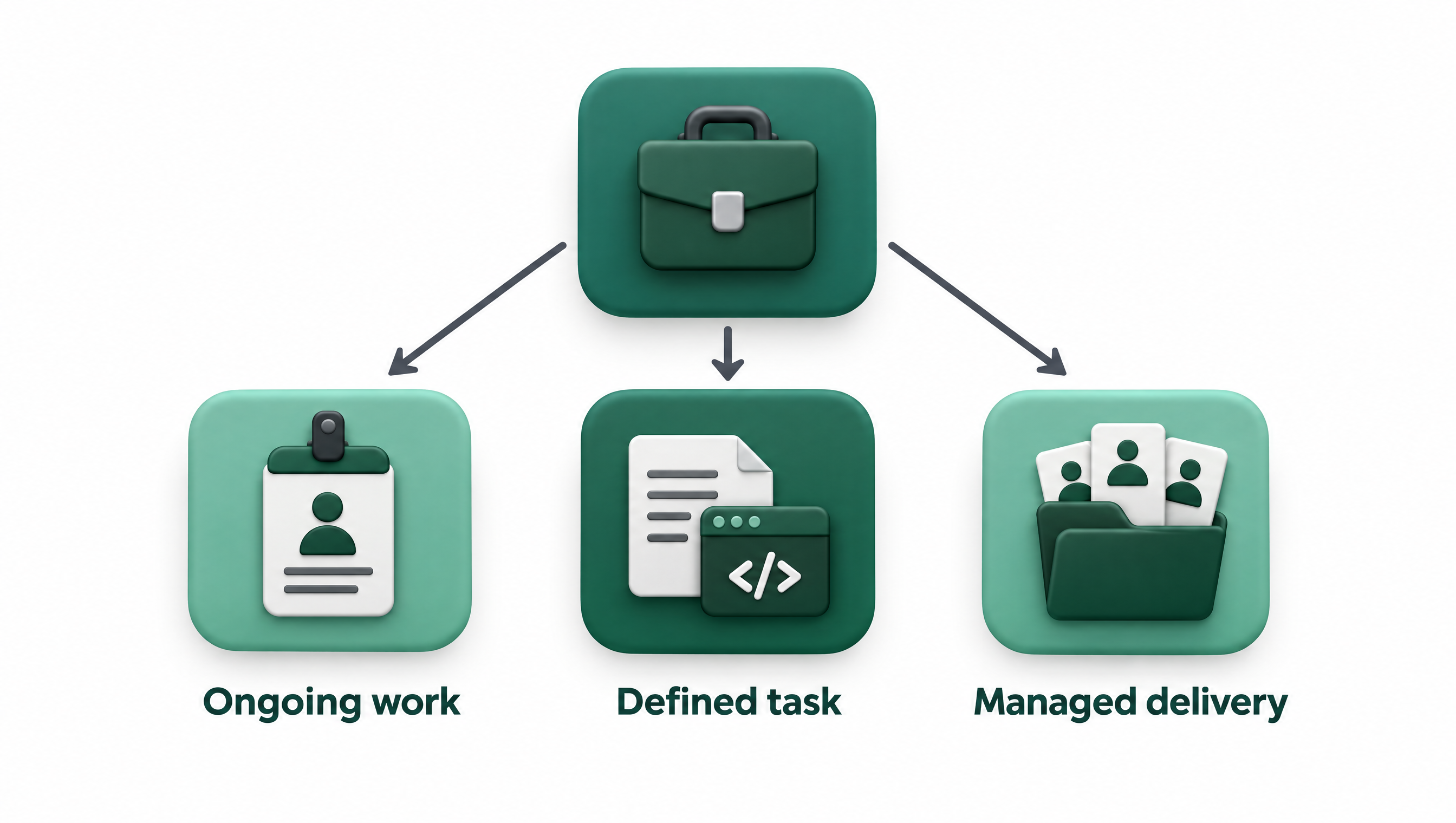
Is the work ongoing? Choose a permanent employee
Use a permanent role when the developer will own systems and continue working as the product changes. Define the role around continuing responsibilities rather than a temporary feature list. If the work has a clear end, compare a freelancer with an agency instead.
Can you define and manage the task? Choose a freelancer
Choose a freelancer when your team can set the scope, provide access, review technical decisions and accept the work. Write down deliverables and maintenance expectations before sourcing. If you need someone else to organize delivery, an agency may fit better.
Do you need managed delivery? Choose an agency
Choose an agency or consultancy when external coordination is part of the requirement. Ask who will do the work, how changes are handled and what happens after handover. Make code ownership, documentation and access part of the agreement.
Do you want to find candidates directly? Choose candidate discovery
Choose direct discovery when your team can run outreach and interviews but needs help finding relevant developers. Set must-haves that can be supported by evidence, then review the context behind each finding. Do not turn repository activity into an automatic hiring score.
If direct sourcing fits your process, use AyHire to build a role-based candidate shortlist for your team to review.
FAQ
How to hire freelance developers?
Define the work, required technical evidence, access needs and review process before searching. Compare freelancers against the same job-related criteria, discuss who will maintain the code and record the agreed scope and responsibilities in the engagement terms.
Will AI replace full stack developer?
AI does not remove the need to decide what to build, assess trade-offs, review output and take responsibility for production systems. Treat AI tool experience as one part of the role where relevant, then evaluate the developer against the work your team actually needs.
How much does it cost to hire a full stack developer?
The cost depends on the engagement model, scope, location, experience and duration. Compare total employment costs for an employee, the agreed project or time basis for a freelancer, and the full engagement terms for an agency. No verified price range is available here.
Where can I hire a full stack developer?
You can hire through direct candidate discovery, applications to a permanent role, freelance channels, referrals, or an agency or consultancy. Pick the channel after deciding whether you need continuing ownership, temporary individual capacity or managed delivery.
Hire a full stack developer salary
Set the salary only after defining the role level, location expectations, responsibilities and employment terms. Use current compensation data for the relevant labor market, and compare like with like rather than mixing salary with freelance fees or agency charges.
Hire a full stack developer near me
Use a local search only when location affects collaboration, employment rules or access to the workplace. State the required location and attendance pattern clearly, but keep technical assessment tied to the role rather than proximity alone.
Ready to research candidates directly? AyHire can help your team create an evidence-linked shortlist to review.
Sources
- AyHire, product capabilities and limitations
- "Should you become a full stack developer?" by Web Dev Cody, embedded video
Last checked: 2026-11-13