On this page
AI powered recruiting software can help with sourcing, screening, candidate tracking or hiring research, but few tools handle every task equally well. AI recruiting software is technology that uses automated analysis or generation to assist with parts of the hiring process. For teams hiring developers, the most useful starting point is often a sourcing or research tool that shows why each person matches the role.
This guide covers four kinds of option and ranks none of them because there is not enough verified, comparable product data for a fair named ranking. Instead, we compare them by job coverage, evidence quality, human review, workflow fit and pricing transparency. For the common need of finding technical candidates outside an existing applicant pool, start with a developer research or sourcing tool.
The short answer
Choose the category that addresses your main hiring bottleneck. Developer research tools suit targeted outbound searches. General sourcing tools cover broader roles. Screening tools help process applicants. Applicant tracking systems manage the hiring workflow. Check the underlying evidence and review controls before relying on any generated recommendation.
- Best for finding developers from public technical work: Developer research tools that assess role requirements against public work and link to supporting evidence.
- Best for broader outbound candidate discovery: General AI sourcing tools that search for people across roles and channels.
- Best for reviewing an existing applicant pool: AI screening tools that help compare applications with stated job criteria.
- Best for managing hiring stages: Applicant tracking systems with AI features for records, communication and workflow support.
| Name | What it does | Best for | Pricing basis |
|---|---|---|---|
| Developer research tools | Find technical candidates and assess public work against role requirements | Teams hiring developers through outbound search | Varies by product |
| General AI sourcing tools | Find possible candidates for open roles | Recruiting across several job families | Varies by product |
| AI screening tools | Help review and compare existing applications | Teams with an applicant pool | Varies by product |
| Applicant tracking systems with AI | Organize candidates and hiring stages, with AI assistance in parts of the workflow | Teams needing a central hiring record | Varies by product |
How we assessed these options
We assessed the categories by the hiring task covered, the evidence available to reviewers, the amount of human control, fit with technical hiring and clarity about cost. We did not rank named products because comparable, verified details about features, prices and limits were not available for enough options.
A useful comparison starts with what enters the system and what comes out. A sourcing tool may begin with a role description and return possible candidates. A screening tool usually starts with people who have already applied. An applicant tracking system focuses on records and movement through hiring stages.
Use these checks when evaluating a product:
- Task fit: Does it source, screen, track or research candidates?
- Evidence: Can a reviewer inspect the information behind a match?
- Control: Can your team set must-haves and reject weak assumptions?
- Coverage: Does it support the roles and candidate sources you need?
- Workflow: Can your team share, review and update candidate decisions?
- Cost clarity: Is the pricing unit clear, including any limits on searches, seats or usage?
We operate AyHire, so our product is discussed as an example of a developer research tool rather than placed first in a ranking. AyHire searches for developers who match a role description, evaluates public profiles against specified must-haves and presents supporting profile links for review. It also checks whether candidates may be open to work and provides a shared shortlist.
What should you look for in AI powered recruiting software?
Look for a close match between the tool and the hiring task, followed by evidence you can inspect and controls your team can change. A useful result should help a recruiter or hiring manager make a better review decision. It should not ask them to accept an unexplained score.
Watch "How to Recruit with AI? (AI Recruiting Software)" on YouTube
Start with one hiring problem
Write down the step consuming attention before comparing software. If you cannot find enough suitable developers, focus on sourcing and research. If you receive many applications, focus on screening. If candidate records are scattered, consider an applicant tracking system.
Avoid buying a broad platform because it has the longest feature list. Features outside your current workflow can add setup work without fixing the problem that led you to shop for software.
Ask what evidence supports a match
For technical roles, a profile summary alone may not be enough. Ask whether reviewers can inspect public work, profile details or other material that supports the assessment. Then check whether the product distinguishes direct evidence from generated interpretation.
A practical test uses a real role and a small sample of results. Review each result against the same must-haves your hiring team already uses. Record false matches, missing evidence and assumptions that need correction.
Keep a person responsible for the final sourcing, screening and hiring decision. AI output should be treated as material for review, not as a decision by itself.
Check where the candidate data comes from
The available candidate pool depends on the sources searched by the product. A developer research tool focused on public technical work serves a different purpose from a system that searches an existing talent database. Decide whether you need applicants, past candidates or people outside your current records.
For developer hiring, consider whether public work helps answer your role-specific questions. A repository or profile can add context, but it does not replace an interview or establish every skill needed for a job.
Test the team workflow
A promising search result still needs review, ownership and follow-up. Check whether recruiters and hiring managers can share a shortlist, inspect the same evidence and record what happens next. If information must be copied between systems, include that work in your assessment.
The video below shows an overview of how AI recruiting software can fit into recruiting work.
Watch "How to Recruit with AI? (AI Recruiting Software)" by LeadLoft.
What are the main kinds of options?
The main categories are developer research, general sourcing, applicant screening and applicant tracking. They overlap, but each begins at a different point in the hiring process. Choose according to your input, such as a role description or applicant pool, and the decision your team needs to make next.
Developer research tools
Developer research tools are designed for teams that need to identify technical candidates outside their current applicant pool. They may use public technical profiles and work to assess whether someone appears to meet role requirements. Their value depends on whether the result includes enough evidence for a knowledgeable reviewer.
AyHire fits this category. Its developer candidate discovery searches for people matching a role description and evaluates public profiles against specified must-haves. Results include supporting profile findings, possible open-to-work status and a shared shortlist. Searches and shortlists can also be made available through Claude Code, Codex, Cursor and other agents over MCP.
Best for
- Teams running targeted outbound searches for developers
- Recruiters who want supporting profile links with each assessment
Strengths
- Focuses on public GitHub work for developer discovery
- Supports role-specific must-haves
- Gives the team material to inspect before outreach
Limits
- It is a hiring research tool, not a full applicant tracking system
- Public profiles cannot answer every question about candidate ability or interest
- A person still needs to review the shortlist and make contact decisions
Who should skip it: Teams that only need to process people who have already applied should start with screening or applicant tracking instead. Teams can also review our guide to GitHub recruiting tools when comparing technical sourcing approaches.
General AI sourcing tools
General AI sourcing tools help recruiters look for possible candidates across more than one job family. They suit teams with recurring outbound hiring needs where broad role coverage matters more than technical work analysis. Their usefulness depends on search coverage, filters, current data and the information shown for each match.
Best for
- Recruiting teams sourcing across technical and nontechnical roles
- Teams that need a broader candidate search rather than GitHub-focused research
Strengths
- Can support several kinds of role
- Keeps outbound discovery separate from application screening
- May help teams build an initial prospect list
Limits
- Broad coverage may provide less depth for evaluating public technical work
- Candidate data and match explanations vary by product
- Outreach features do not establish whether a candidate is suitable
Who should skip it: Teams whose main issue is applicant review should choose screening software. A team hiring only developers should compare the depth of technical evidence with a specialist research tool.
AI screening tools
AI screening tools work with people who have already entered the hiring process. They can help organize application material and compare it with job criteria, but the team should be able to inspect and challenge the output. This category does not solve a shortage of applicants because it begins after candidates apply.
Best for
- Teams receiving enough applications to require structured review
- Hiring processes with clear, job-related screening criteria
Strengths
- Focuses review on an existing applicant pool
- Can support consistent use of stated criteria
- May help reviewers organize application information
Limits
- It does not replace candidate sourcing
- Weak job criteria can produce weak recommendations
- Automated assessments require human review and governance
Who should skip it: Teams with too few suitable applicants need sourcing or developer research first. Teams seeking a central record for every hiring stage may need an applicant tracking system instead.
Applicant tracking systems with AI
Applicant tracking systems organize candidate records and hiring stages. Some include AI assistance for parts of sourcing, review or communication, but workflow management remains their central role. They suit teams that need one place to coordinate an established hiring process across recruiters, managers and open roles.
Best for
- Teams needing a central candidate record
- Employers coordinating several roles and hiring stages
Strengths
- Organizes candidate progress through the process
- Gives teams a shared place for hiring records
- Can reduce the need for separate tracking documents
Limits
- AI features may not provide specialist developer research
- Setup can exceed the needs of a small, targeted search
- A system of record does not create a suitable candidate pool by itself
Who should skip it: A team solving one narrow sourcing problem may not need a larger hiring platform. Compare the core workflow first, then treat AI features as a secondary criterion.
How should you choose?
Choose by deciding where candidates come from, what evidence reviewers need and where the result must go next. Then test the smallest realistic workflow with a live role. A short evaluation based on actual must-haves reveals more than a generic demonstration or a long feature checklist.
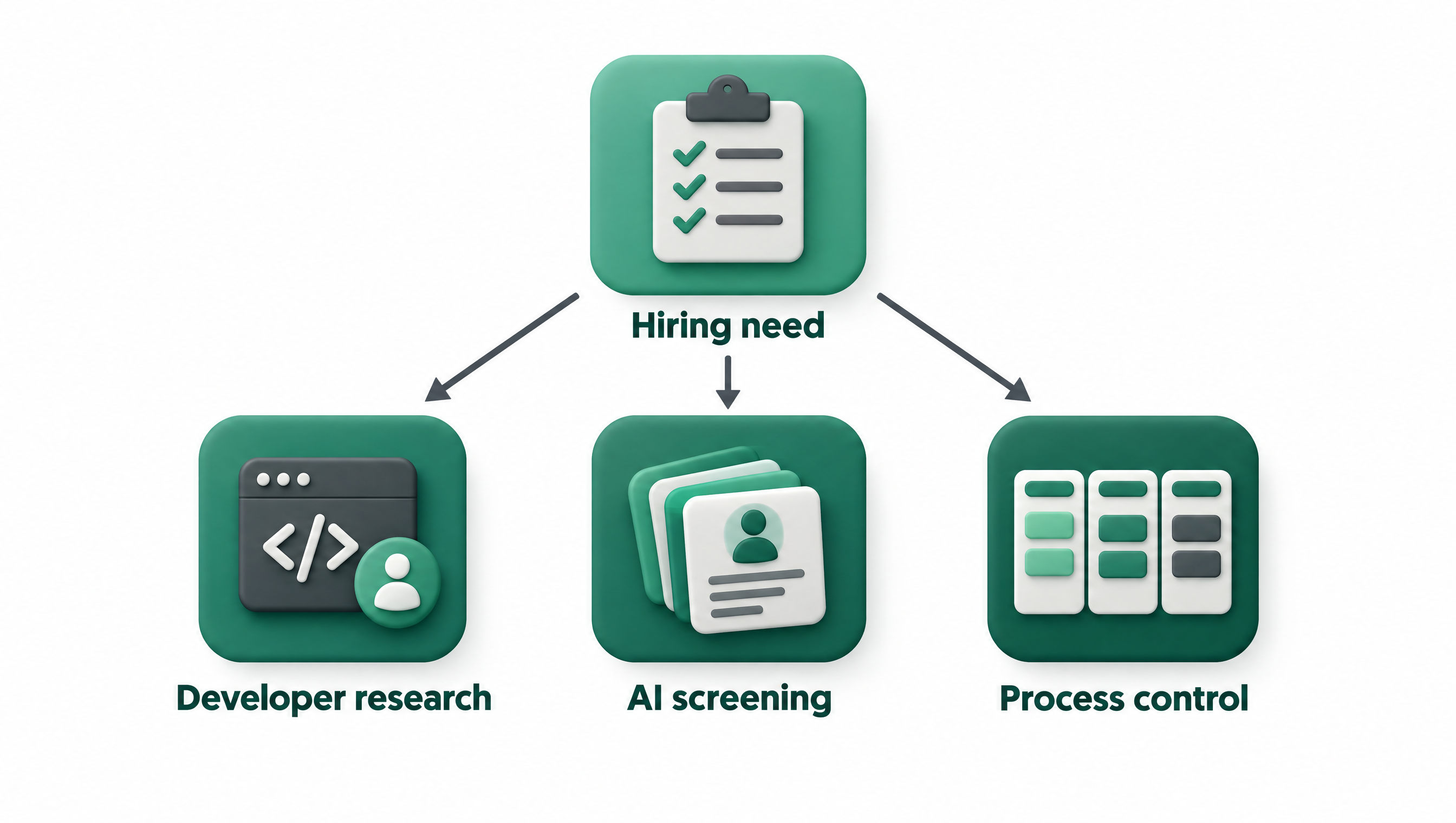
Choose developer research for technical outbound hiring
Use a developer research tool when you need to find developers beyond your applicant pool and public technical work is relevant to the role. Check whether results link to supporting material, reflect your must-haves and let hiring managers review the same shortlist.
Choose general sourcing for broader role coverage
Use a general sourcing tool when your team recruits across many job families. Ask which candidate sources it searches and how it explains matches. Confirm that the available filters reflect the requirements your team can defend.
Choose screening for an existing applicant pool
Use screening software when candidate volume has moved the bottleneck from discovery to review. Define the criteria before testing the product. Compare its output with an independent human review of the same applications.
Choose an applicant tracking system for process control
Use an applicant tracking system when candidate records, ownership and hiring stages need a central home. Map your required workflow before reviewing AI features. A useful assistant inside the wrong process will not fix the underlying workflow.
If your immediate need is finding developers from public work, start by testing AyHire's developer research workflow against one real role and a written set of must-haves.
FAQ
These answers address common searches about AI recruiting software, free products, community recommendations and tool categories. Product details and prices can change, so confirm current terms before adopting a tool. Base the final choice on your own role, candidate source, review process and data requirements.
Best ai powered recruiting software
The best AI powered recruiting software is the option that fits your current hiring bottleneck and provides reviewable evidence. Use developer research for technical outbound hiring, general sourcing for broader discovery, screening for existing applicants and an applicant tracking system for process management.
Ai powered recruiting software free
Free AI powered recruiting software can be useful for testing a narrow workflow, but check its usage limits, data access, export options and review controls. Do not assume that a free plan includes the same candidate coverage or team features as a paid plan.
Ai powered recruiting software reddit
Reddit discussions can help you identify recurring complaints and practical workflow questions, but they should not be your only evaluation source. Verify current features and pricing with the vendor, then test the product using your own role requirements and candidate review process.
Recruitment software tools
Recruitment software tools include sourcing products, screening tools, applicant tracking systems and specialist research tools. Choose the category first, then compare products within that category using the same task, evidence and workflow criteria.
AI sourcing tools for recruiting
AI sourcing tools for recruiting help identify possible candidates before they apply. For developer roles, check whether a tool can assess public technical work, link to supporting evidence and apply the must-haves defined for the role.
Top 10 recruiting tools
A top 10 recruiting tools list is only useful when every product is assessed for the same task and with current, comparable evidence. A shorter category comparison is safer when prices, features and product scope cannot be verified consistently.
Recruitment software free
Free recruitment software may suit a small trial or a simple hiring process. Check limits on users, jobs, candidate records, searches and exports, and confirm how candidate data is handled before adding real hiring information.
Start with one real hiring problem, write down the evidence needed for a decision and test the matching category against that standard.
Sources
The product facts about AyHire come from its primary product page. The embedded video information comes from the publisher's YouTube page. No named third-party products were ranked because comparable primary product data was not available for a fair assessment.
Last checked: 2026-11-11