On this page
Effective AI coding interview examples have one trait in common: they test how a candidate directs, checks and improves AI-generated work, rather than whether the tool can produce code. An AI-enabled coding interview is a technical assessment where a candidate may use an AI assistant while interviewers assess the candidate's decisions and final work.
Below are six formats you can copy. They cover feature work, debugging, code review, framework use, testing and system design. Each format makes different skills visible, so choose the one that matches the work in your role. Set the permitted tools and evaluation criteria before the interview, then give every candidate the same core task and constraints.
| Example | What it does | Who it suits |
|---|---|---|
| Small feature with AI | Tests planning, implementation and verification | Product engineering roles |
| Debugging an AI-generated change | Tests diagnosis and correction | Backend and full-stack roles |
| Reviewing an AI-generated pull request | Tests code review and engineering judgment | Senior developers and technical leads |
| Framework task with documentation | Tests unfamiliar codebase navigation | Framework-heavy teams |
| Test-first repair task | Tests failure analysis and test design | Quality-focused engineering teams |
| System design followed by a code slice | Connects architecture decisions to implementation | Senior and staff-level roles |
1. A small feature built with AI
This example asks the candidate to add one bounded feature to an existing codebase while using an approved AI assistant. It works because the interviewer can observe how the candidate reads the code, breaks down the task, gives context to the assistant and checks the resulting change before calling it complete.
Choose a task with a clear boundary, such as adding validation to an existing endpoint or extending a small command-line tool. Provide a working project, acceptance criteria and a short list of files that may be relevant. Avoid hidden requirements that turn the exercise into a guessing test.
How to run it:
- Give the candidate the repository, task and permitted tools.
- Ask for a short plan before any code changes.
- Let the candidate use AI while sharing prompts and generated output.
- Ask the candidate to run checks and explain the final diff.
This format makes planning and verification visible. Its main limit is that a small feature may not reveal how the candidate handles a large or unfamiliar system. Skip it when the role is mainly about diagnosis, architecture or reviewing other developers' work.
2. A debugging task with an AI-generated change
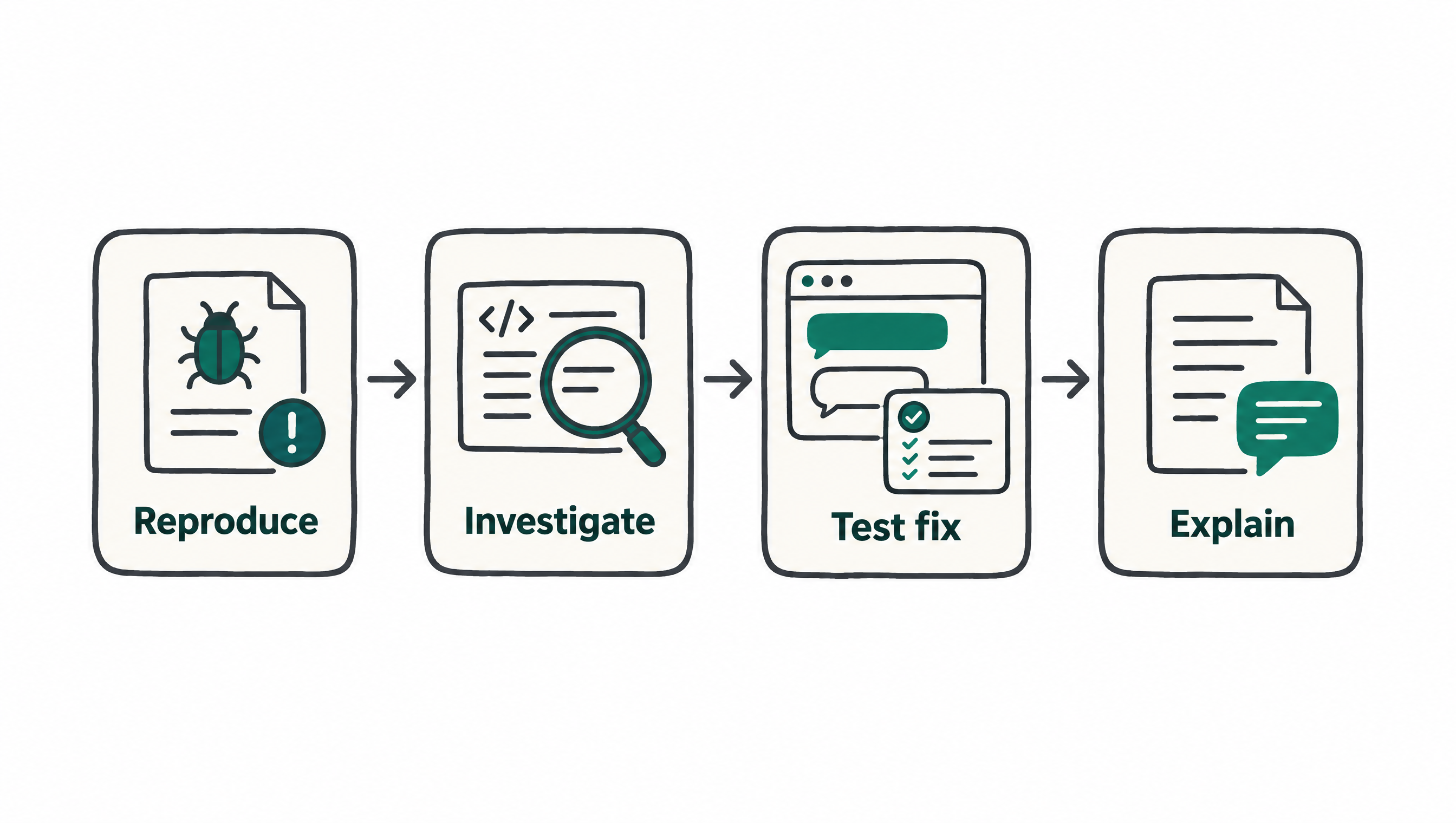
In this format, the candidate receives code containing a reproducible fault and may use AI to investigate it. The useful evidence is not the assistant's proposed fix. It is how the candidate reproduces the issue, tests possible causes, rejects weak suggestions and confirms that the correction addresses the original failure.
Watch "Coding interviews have become insane" on YouTube
Start with a project that runs and a problem that can be observed through a failing test, incorrect response or logged error. Tell the candidate what users experience, but do not prescribe the cause. Keep unrelated setup work out of the exercise so the interview stays focused on diagnosis.
How to run it:
- Provide the failing behavior and steps to reproduce it.
- Ask the candidate to state possible causes before prompting an assistant.
- Have the candidate inspect and test each proposed fix.
- Require a final explanation of the cause and evidence for the correction.
The video below shows one perspective on how demanding coding interviews have become and can help a hiring team discuss whether its exercise measures job-related work.
This example suits roles where production diagnosis matters. Its limit is that success can depend heavily on familiarity with the language, logs or test setup. Skip it if your main concern is greenfield product work.
3. An AI-generated pull request review
A review exercise gives the candidate a proposed change produced with AI and asks them to assess it before approval. It works because candidates cannot rely on code generation alone. They must identify risks, question assumptions, connect the change to requirements and decide what must change before the code is accepted.
Prepare a small pull request with a clear purpose and a few meaningful issues. These can include incomplete validation, an incorrect edge case or a test that does not prove the intended behavior. Do not fill the change with superficial style problems, since that can distract from engineering judgment.
How to run it:
- Share the requirement, diff and relevant surrounding code.
- Let the candidate use AI to inspect or explain the change.
- Ask for review comments ordered by impact.
- Discuss whether the candidate would approve, request changes or rewrite part of it.
This format is well suited to senior developers and technical leads. It reveals review habits without requiring a full implementation. Its limit is that it provides less evidence about how the candidate writes code from a blank starting point. Skip it for junior roles where pull request ownership is limited.
4. A framework task with documentation and AI
This example places the candidate in a small application built with a framework and permits both documentation and an AI assistant. The aim is to see how they locate the right extension point, verify framework-specific advice and avoid accepting code that does not match the project's version, structure or conventions.
Use a framework that matters to the role, but keep the requested change narrow. Tell candidates in advance which framework they will use so the interview does not depend on surprise recall. Provide the project configuration and local instructions needed to run the application.
How to run it:
- Give the candidate a working framework project and one change request.
- Ask them to locate the relevant route, component or service.
- Permit documentation and AI while they implement the change.
- Ask how they confirmed that generated advice fits the project.
This task suits teams whose daily work depends on framework conventions. The main limit is that it can overvalue prior exposure to one stack. Skip it when you want to measure general programming ability rather than knowledge of a particular ecosystem.
5. A test-first repair task
A test-first repair asks the candidate to turn a reported defect into a failing test before fixing the implementation. AI may help propose cases or code, but the candidate must decide what behavior matters. This makes the quality of their problem model visible before a generated patch can hide weak reasoning.
Give the candidate a concise bug report, a runnable test suite and the relevant module. The report should contain enough detail to define expected behavior without revealing the exact code change. Ask the candidate to explain why the new test would have caught the defect.
How to run it:
- Present the defect and expected behavior.
- Ask for a failing test that reproduces the problem.
- Permit AI during test and implementation work.
- Review the fix, regression test and any uncovered edge cases.
This example suits teams that expect developers to protect behavior with automated tests. Its limit is that test harness knowledge can affect the outcome. Skip it when the role rarely involves maintaining an existing codebase.
6. A system design followed by one code slice
This format begins with a small system design problem and ends with implementation of one narrow part. It works because the interviewer can compare the candidate's stated architecture with their code. AI can help explore options, but the candidate must select an approach, define boundaries and explain why the implementation follows the design.
Choose a problem that can be discussed without building an entire service. After the design conversation, select one component such as a request validator, queue consumer interface or cache policy. State that production completeness is not expected, then assess the consistency of the decisions.
How to run it:
- Present the system goal, constraints and expected users.
- Ask the candidate to outline components and trade-offs.
- Select one component for a short implementation.
- Let the candidate use AI, then compare the code with the design.
This option suits senior and staff-level hiring because it connects abstract decisions to code. Its limit is time. A short session can make either the design or implementation too shallow. Skip it when the role does not include architecture ownership.
How to pick the right one to start with
Start with the task that most closely resembles a decision the person will make in the role. Do not choose an exercise because it appears difficult. Choose it because the candidate's actions produce evidence your interview team can evaluate consistently and discuss after the session.
Choose the feature task for product delivery
Use the small feature example when developers in the role will regularly extend an existing product. Assess whether the candidate understands the request, finds the correct part of the codebase and verifies the result. Keep visual polish or obscure syntax out of the score unless those details matter to the job.
Choose debugging or test-first repair for maintenance work
Use debugging when you need to see investigation under uncertainty. Choose test-first repair when defining expected behavior and preventing recurrence matter more. Both formats should include a reproducible problem, since interviewers otherwise risk judging candidates on different interpretations of the task.
Choose pull request review for senior hiring
Use the review task when the role includes approving changes or guiding other developers. Ask interviewers to distinguish blocking defects from optional improvements. That distinction shows whether the candidate can focus attention where it matters rather than producing a long list of minor comments.
Choose framework or design work for specialized roles
Use the framework task when stack knowledge is a stated requirement. Use design followed by a code slice when the person will own technical boundaries as well as implementation. In both cases, tell candidates what tools they may use and assess their decisions, not the volume of generated code.
Before scheduling interviews, you can use AyHire's developer candidate discovery to search public GitHub work against role requirements and create an evidence-linked shortlist. AyHire supports candidate research before the interview. It does not run or score the coding exercises described here.
A simple scorecard can cover:
- Understanding of the task and constraints
- Quality of the plan and prompts
- Review of generated output
- Verification through tests or direct checks
- Explanation of trade-offs and final decisions
Use the same core scorecard for every candidate taking the same exercise. Record what the candidate did and said rather than inferring ability from how polished an AI response appeared.
FAQ
Ai coding interview examples reddit
Reddit discussions can help you collect candidate perspectives, but treat them as informal accounts rather than a standard interview specification. Confirm the permitted tools, task format and evaluation criteria directly with the recruiter or hiring team. For employers, publish those rules before the session so candidates do not have to reconstruct them from forum posts.
Ai coding interview examples pdf
A useful AI coding interview PDF should contain the task, permitted tools, time boundary, starter repository instructions and scorecard. You can turn any example on this page into a candidate handout, but keep interviewer-only faults or scoring notes in a separate document. Test the instructions internally before using them with candidates.
AI coding interview practice
The most useful AI coding interview practice is to solve a small task while recording your prompts, code changes and verification steps. Practise explaining why you accepted or rejected each suggestion. Hiring teams can run the same exercise internally to find unclear requirements and setup problems before interviewing candidates.
Meta AI-enabled coding interview
Ask the Meta recruiter for the current format and an official practice task because interview processes can change. Do not assume that a forum account describes the round you will receive. Confirm which AI tools are permitted, whether prompts are visible and what technical environment will be used.
Best AI for interview answers
The best tool is one permitted by the employer and suitable for the coding environment, but it should not replace the candidate's reasoning. A candidate still needs to check generated code, explain decisions and correct errors. Employers should score those actions rather than treating tool choice as proof of skill.
Free mock interview AI
You can practise without a dedicated mock-interview product by using an approved AI assistant with a small public codebase and a written task. Set a time boundary, save the prompt history and review the final diff afterward. Do not paste private employer code or confidential interview material into an external service.
If your team needs developers to invite into this process, start with AyHire and build a shortlist based on evidence from public GitHub work.
Sources
Last checked: 2026-11-25